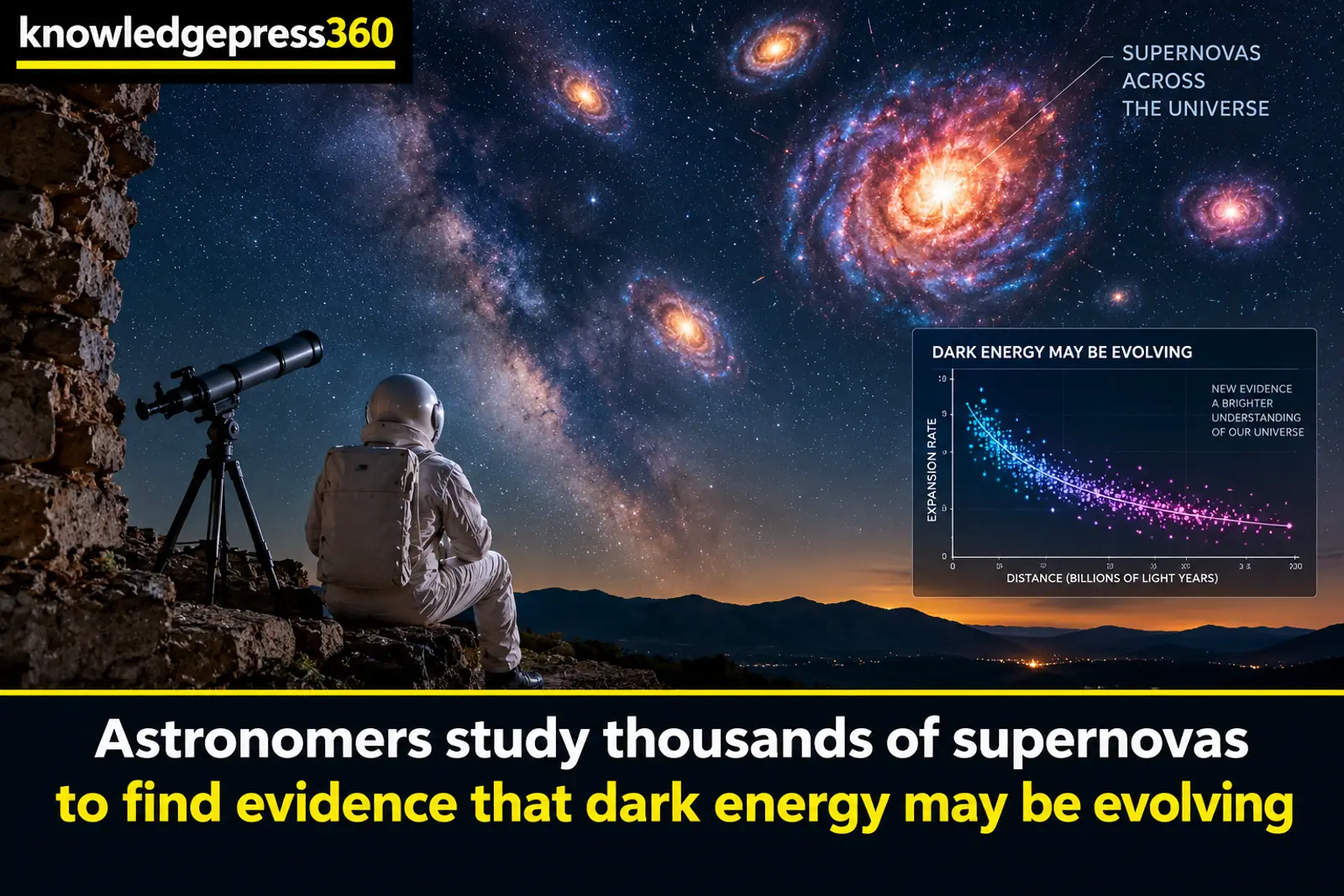
Modern astrophysics relies on fundamental assumptions regarding the forces that govern the cosmos, yet recent observational campaigns are beginning to challenge these long-held paradigms. At the centre of this scientific reassessment is dark energy, the mysterious repulsive force responsible for driving the accelerated expansion of the universe. For decades, researchers treated this phenomenon as an unchanging fixture of reality. However, a comprehensive new analysis of nearly three thousand stellar explosions has provided compelling hints that dark energy is not static, but actively evolving over time. This development carries profound implications for our comprehension of cosmic history and the ultimate fate of the universe.
Analysing thousands of type Ia supernovas
A new astronomical catalog comprising nearly 3,000 white dwarf type Ia supernovae has offered researchers an unprecedented glimpse into the expansion history of the cosmos. These luminous stellar detonations occur when dead stellar remnants accrete matter from binary companions until reaching a critical mass threshold. Because these explosions exhibit highly consistent peak brightness levels, astronomers use them as reliable cosmic distance markers to chart the expansion rate of space across billions of light years. By synthesising three decades of accumulated observational data into a single, unified framework, researchers were able to account for complex distortions such as gravitational lensing and intervening cosmic dust.
The resulting dataset aligns closely with groundbreaking findings released in 2024 by the Dark Energy Spectroscopic Instrument collaboration, which similarly pointed toward a weakening influence of dark energy. Within the prevailing standard model of cosmology, known as the cosmological constant framework, dark energy is presumed to maintain a fixed density uniformly throughout an expanding universe. The latest supernova observations, however, suggest that this foundational premise may be flawed. Instead of maintaining constant strength, the force accelerating the cosmos appears to be shifting dynamically as space continues to stretch outward.
Navigating statistical limits and models
Despite the scale and rigour of the recent analysis, the observed deviations from standard theoretical predictions still fall short of the rigorous statistical thresholds required to claim an absolute discovery. Leading astrophysicists currently categorise the findings as a robust hint or an intriguing anomaly rather than definitive proof of new physics. Historical studies utilising space-based observatories have previously established that dark energy has operated as a cosmic repulsive force for the vast majority of the universe's history. Yet tracking minute variations in its strength across deep time remains an exceptionally intricate analytical challenge fraught with potential measurement uncertainties.
Theoretical physicists are actively examining whether a waning dark energy can be reconciled with modern particle physics or string theory frameworks. Whether these deviations represent genuine cracks in the standard cosmological model or subtle systematic errors in instrument calibration remains a subject of intense debate within the scientific community. Because dark energy accounts for a significant portion of the total energy density of the universe, even minor alterations in its behavior demand rigorous cross-validation from independent observational techniques before theorists can construct viable alternative models.
Future cosmic surveys and observations
Resolving the enigma of evolving dark energy will require the deployment of next-generation instruments designed to map the large-scale structure of the universe with extraordinary precision. Upcoming scientific milestones include expansive survey projects, such as the Dark Energy Spectroscopic Instrument collaboration's ongoing initiative to catalog tens of millions of galaxies. By extending these cosmic maps across greater distances and incorporating relic light from the early universe, researchers aim to test whether the currently observed deviations persist within larger datasets.
As these massive observational campaigns progress, the astronomical community moves closer to determining whether our standard theoretical framework requires a fundamental rewrite. If future surveys confirm that dark energy is indeed weakening or otherwise changing, textbooks detailing the evolution and ultimate destiny of the universe will need substantial revision. Until then, scientists continue to scrutinise the faint signals emanating from ancient exploding stars, searching for definitive answers hidden within the expanding fabric of space.