A Month of Celestial Fireworks
August 2026 is shaping up to be one of the most rewarding months for anyone who enjoys looking up. Within a span of three weeks the night sky will host a total solar eclipse, the annual Perseid meteor shower at its peak, Venus at its brightest evening apparition, and a deep partial lunar eclipse. Each event offers a different kind of spectacle and a set of practical considerations for safe, rewarding observation.
12 August: Total Solar Eclipse Across the North
The headline of the month is the total solar eclipse that sweeps across the high latitudes of northern Russia, Greenland, Iceland and the northern fringe of Spain, with a small sliver of Portugal also falling inside the path of totality. In the United States the eclipse will be seen as a partial event, ranging from a thin bite in Alaska to a more substantial covering in the Carolinas.
During totality the Moon completely blocks the Sun’s photosphere, turning day into a brief twilight and revealing the Sun’s faint corona. The eclipse will begin at approximately 09:45 UTC and reach maximum coverage around 10:30 UTC for locations on the centre line. Observers outside the path will still witness a partial eclipse, with the fraction of the Sun obscured varying with latitude.
How to Watch Safely
Never look directly at the Sun without proper protection. Certified eclipse glasses or a solar‑filter‑equipped viewer are essential any time the Sun is exposed, even during a partial phase. Regular sunglasses, smoked glass or unfiltered telescopes, binoculars or cameras can cause permanent eye damage. If you plan to photograph the event, attach a solar filter to the front of the optical instrument rather than the eyepiece.
12‑13 August: Perseid Meteor Shower Peak
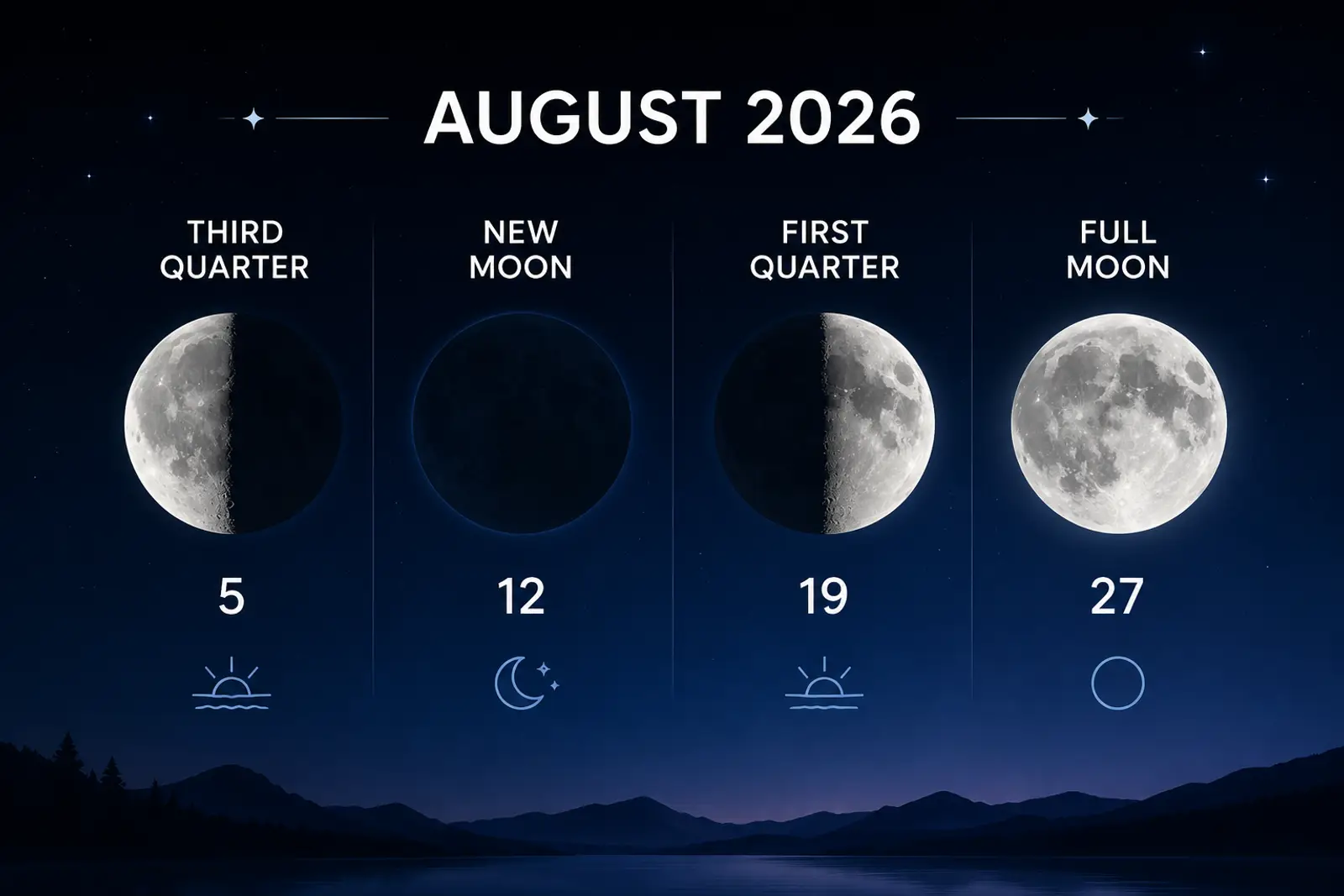
Just hours after the eclipse, the Perseid meteor shower reaches its zenith. The shower peaks during the early hours of the night on the 13th, benefitting from the new Moon that occurs on the 12th – a dark sky that maximises visibility of faint meteors.
The Perseids are the result of Earth moving through a dense stream of dust left by Comet Swift‑Tuttle. When those tiny particles enter the atmosphere they vaporise, creating bright streaks that appear to radiate from the constellation Perseus, which will be just above the eastern horizon after astronomical twilight.
Viewing Advice
- Location: Find a dark, open site away from streetlights; the more of the horizon you can see, the better.
- Orientation: Start by looking toward the northeast where Perseus rises, but allow your eyes to wander – meteors can blaze across any part of the sky.
- Eyesight: Give your eyes at least 30 minutes to adapt to the darkness. Avoid using bright screens or flashlights.
- Timing: The shower’s activity builds after midnight and often peaks around 02:00–04:00 local time.
14‑16 August: Venus at Greatest Eastern Elongation
A few days after the Perseids, Venus reaches its greatest eastern elongation – the point at which the planet appears farthest east of the Sun and therefore highest above the western horizon after sunset. From mid‑August onward, Venus will sit low in the western sky, outshining any star in its vicinity with a steady magnitude of about –4.6.
Through a modest telescope Venus will present a half‑lit disc, reminiscent of a thin crescent moon, allowing observers to appreciate the planet’s cloud‑wrapped atmosphere and its distinctive yellow‑white hue.
Simple Spotting Tips
- When: Look roughly 30 minutes after sunset while the sky is still deepening but the horizon is clear.
- Where: Scan the western horizon just above the line where the Sun has set – Venus will be the brightest point there.
- Equipment: A pair of binoculars or a small telescope will reveal the planet’s illuminated limb; even naked‑eye observers will notice its brilliance.
27‑28 August: Partial Lunar Eclipse
The month concludes with a partial lunar eclipse that will be visible from most of the Americas, as well as parts of Europe and Africa. The eclipse begins on the night of the 27th (local time) and continues into the early hours of the 28th for western time‑zones.
At maximum, about 93 % of the Moon’s disc will be immersed in Earth’s umbral shadow. The Moon will not be completely obscured, but the covered portion will acquire a deep, coppery‑red tint – a visual reminder of Earth’s atmosphere scattering sunlight.
Observing Without Gear
Unlike a solar eclipse, a lunar eclipse poses no risk to eyesight; it can be watched safely with the naked eye. Binoculars or a small telescope can enhance the contrast between the illuminated and shadowed portions, and will also reveal the subtle curvature of Earth’s shadow moving across the lunar surface.
Putting It All Together: A Practical Calendar
| Date | Event | Visibility | Key Tips |
|------|-------|------------|----------|
| 5 Aug | Last Quarter Moon | Global | Good for early‑evening photography of lunar features. |
| 12 Aug | Total Solar Eclipse (totality) | Northern Russia, Greenland, Iceland, northern Spain, Portugal | Use certified solar glasses; plan travel to a clear‑sky location. |
| 12‑13 Aug | Perseid Meteor Shower peak | Global (dark‑sky sites) | Dark site, northeast horizon, let eyes adapt. |
| 14‑16 Aug | Venus greatest eastern elongation | Global (western sky) | Look low after sunset; binoculars reveal half‑lit disc. |
| 27‑28 Aug | Partial Lunar Eclipse (93 % coverage) | Americas, parts of Europe/Africa | No special equipment needed; binoculars improve detail. |
Why August 2026 Stands Out
Astronomical events often cluster, but the 2026 August line‑up is unusual in its breadth. A total solar eclipse is a rare treat for most observers, occurring roughly every 18 months somewhere on Earth, yet the next one visible from Europe after 2026 will not arrive until 2035. Coupled with the Perseids – one of the most prolific meteor showers – and a striking display of Venus, the month offers multiple, distinct experiences for novices and seasoned skywatchers alike.
Moreover, the partial lunar eclipse later in the month provides a gentle, accessible finale. Its deepening shadow offers a visual lesson in how Earth’s atmosphere filters sunlight, an effect that has fascinated astronomers for centuries.
Final Thoughts
Whether you are planning a road‑trip to the Arctic to chase totality, setting up a backyard telescope for Venus, or simply lying on a blanket to watch the Perseids streak across a dark sky, August 2026 delivers a compact programme of celestial events that reward both preparation and spontaneity. Remember the safety basics for solar viewing, give your eyes time to adjust for meteor hunting, and enjoy the quiet beauty of a lunar eclipse with no special gear required. The night sky is generous this month – all that remains is to look up.