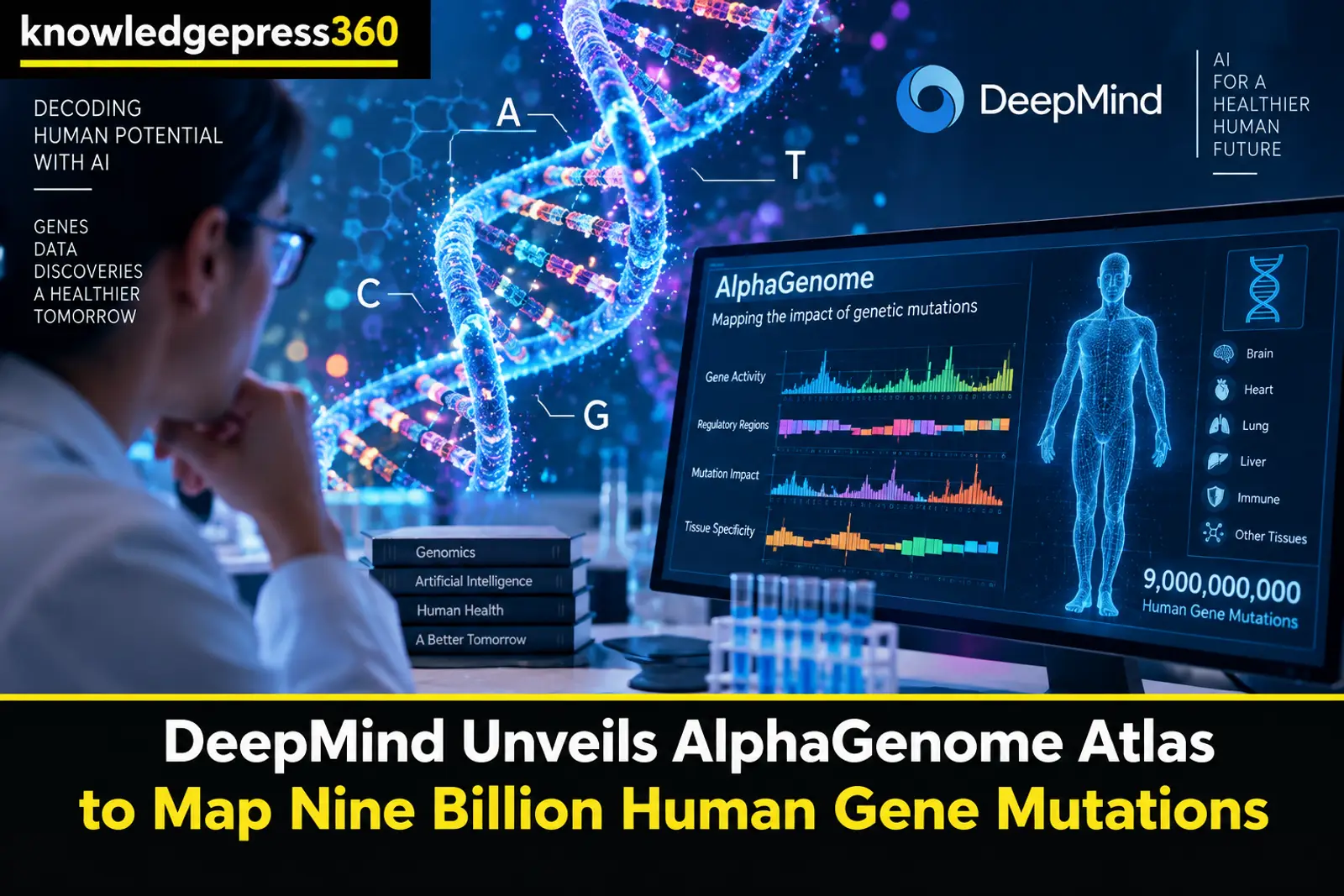
The mapping of the human genome provided science with a monumental instruction manual for human biology, yet researchers have long struggled to interpret its complex non-coding regions and subtle variations. Only a tiny fraction of our three billion DNA bases actively encode proteins, leaving the vast majority of genetic code diabolically difficult to decipher. To bridge this profound knowledge gap, Google DeepMind has unveiled the AlphaGenome Atlas, a revolutionary artificial intelligence database that charts the predicted biological consequences of all nine billion possible single-letter DNA mutations in the human genome. By eliminating the historical bottleneck of evaluating genetic variants one by one, this comprehensive release promises to accelerate the diagnosis of rare disorders and deepen our understanding of common illnesses.
Unveiling The Mutation Database
Built by deploying DeepMind’s advanced AlphaGenome AI model across a human reference genome, the newly released atlas evaluates every single nucleotide substitution alongside more than 100 million short insertions or deletions. The resulting precomputed catalog spans an astonishing one petabyte of data, making it vastly larger than previous computational repositories. Previously, scientists had to run predictive algorithms through tedious individual queries or conduct painstakingly slow laboratory experiments to understand how specific DNA changes influence gene regulation. With the launch of the AlphaGenome Atlas, researchers can instantly access a complete map of genetic variation through a dedicated web interface simply by opening a browser. Pushmeet Kohli, vice president for research and head of the artificial intelligence for science team at DeepMind, described the milestone as a vital step toward finally learning how to read the complex language of the human blueprint.
Scoring Variant Impact
Navigating a petabyte of genetic predictions presents a formidable challenge for working biologists, prompting the developers to introduce targeted analytical tools alongside the raw data. DeepMind collaborated with academic partners to create the AlphaGenome Variant Impact score, a single unified metric designed to help researchers efficiently discern potentially disease-causing mutations from harmless genetic variants. Furthermore, the atlas is currently available completely free of charge for non-commercial academic research, democratising access to high-tier computational biology. Commercial access paths are also slated for future deployment through Google Cloud and Isomorphic Labs, ensuring that both public institutions and private developers can eventually harness the predictive framework for therapeutic innovation.
Interpreting Scientific Limitations
Despite the unprecedented scale and generosity of the release, independent bioinformaticians urge caution regarding the absolute limits of computational modelling. Experts point out that while the atlas dramatically scales up access to predictive insights, computer-generated forecasts cannot completely replace empirical laboratory experiments or individualized clinical diagnostics. Factors specific to individual patients and complex cellular environments mean that automated predictions must be treated as powerful exploratory guides rather than definitive medical diagnoses. Moreover, while academic access is immediate and free, precise pricing structures and commercial licensing terms for enterprise users remain subject to future announcements as Google Cloud prepares its rollout. Establishing the exact margin of error for individual computational variants will likewise require ongoing empirical validation from the broader scientific community.
Future Genomic Horizons
As thousands of academic researchers begin querying the browser-based platform to uncover hidden genetic mechanisms, the atlas marks a transformative turning point for modern genomics. The coming months will likely see independent laboratories putting the petabyte-scale predictions to the test, verifying computational inferences against bench experiments and clinical outcomes. As commercial licensing frameworks take shape on Google Cloud, the broader biotechnology sector will evaluate how best to integrate these predictive models into drug discovery pipelines. Ultimately, the success of the AlphaGenome Atlas will be measured by its ability to translate raw computational power into tangible medical breakthroughs, helping science finally decode the intricate rules that govern human health and disease.