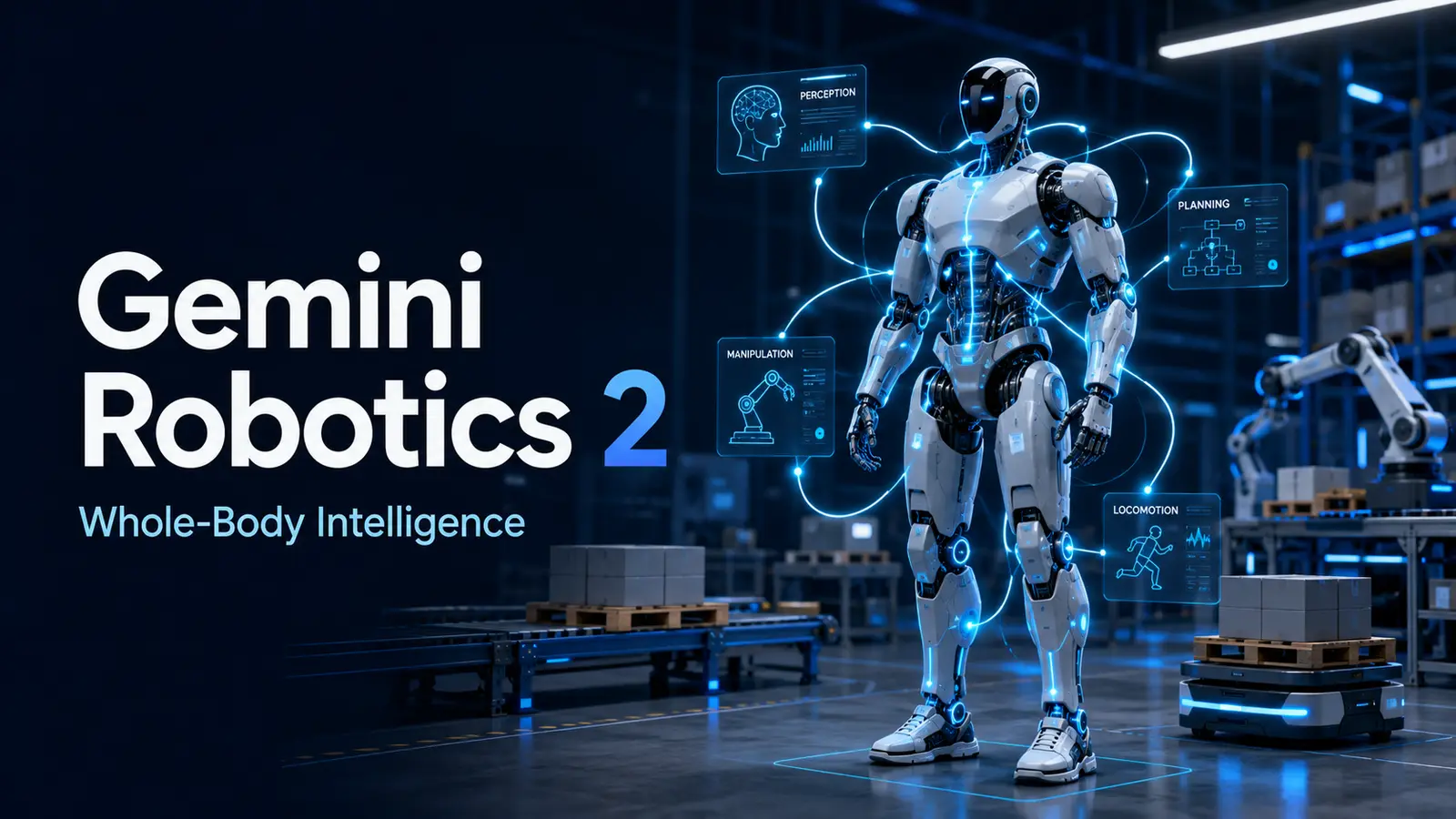
The next leap in industrial automation may not come from a new robotic arm or sensor, but from machines capable of understanding and coordinating their entire bodies. DeepMind’s Gemini Robotics 2 introduces a new approach to robotics by combining perception, reasoning and movement into a unified intelligence framework. The system represents a shift away from narrowly programmed robotic actions toward machines that can interpret instructions, adapt to changing environments and perform complex physical tasks with greater flexibility [1].
By extending artificial intelligence beyond digital environments and into the physical world, Gemini Robotics 2 highlights a future where robots could support manufacturing, warehouse operations, research laboratories and service environments. While the technology remains in an early stage, its development demonstrates how AI is moving from software assistants toward embodied systems capable of interacting with real-world environments.
From Isolated Modules to Integrated Agency
Traditional industrial robots usually depend on separate systems working together. Cameras collect information, planning algorithms decide movements, and controllers execute physical actions. Although this approach has enabled modern automation, it often makes robots difficult to adapt when conditions change.
Gemini Robotics 2 introduces a more integrated approach through vision-language-action models that connect what a robot sees, understands and does. Instead of separating perception, reasoning and movement into disconnected processes, the system allows robots to interpret visual information, understand instructions and generate physical actions within a unified AI framework. [1]
The Gemini Robotics ecosystem includes different intelligence layers. Gemini Robotics provides action capabilities, Gemini Robotics-ER 2 supports higher-level reasoning and planning, while Gemini Robotics On-Device 2 enables local processing directly on robotic hardware. Together, these systems allow robots to analyse environments, complete multi-step tasks and adjust their behaviour based on changing conditions. [1][2][3]
Safety and Adaptability in Real‑World Settings
Safety remains one of the biggest challenges for robots operating near humans. Traditional industrial robots often depend on fixed programming, restricted areas and emergency stopping systems. However, real workplaces are constantly changing, requiring machines to respond more intelligently.
Gemini Robotics 2 improves adaptability by allowing robots to understand instructions, recognise situations and adjust their actions. Google DeepMind has evaluated its embodied reasoning systems on safety-related tasks, including identifying unsafe requests, recognising uncertainty and determining when human assistance may be required. [1][4]
The system is designed to work together with existing safety mechanisms rather than replacing them. Physical safeguards, motion controllers and human supervision remain essential for reliable industrial deployment.
A major advantage of AI-powered robotics is the ability to reduce the need for extensive reprogramming. Gemini Robotics On-Device 2 demonstrates the ability to transfer learned behaviours across different robotic platforms using relatively small amounts of demonstration data. [1][3]
Whole-Body Intelligence and Advanced Robotic Skills
One of the defining features of Gemini Robotics 2 is whole-body intelligence. Instead of focusing only on robotic arms or individual movements, the system coordinates actions across the entire robot, including balance, navigation, reaching and object manipulation.
Google DeepMind has demonstrated robots completing complex tasks that require multiple forms of coordination, such as moving through an environment, identifying objects and performing multi-step instructions. [1]
The system has also been tested with different robotic hands and manipulation platforms, including tasks involving object handling, precise movements and industrial-style interactions. [1]
However, human-level robotic dexterity remains a significant challenge. Robots still struggle with highly delicate manipulation, unpredictable environments and tasks requiring advanced physical understanding. Continued improvements will be necessary before these systems can operate reliably in all workplace conditions. [3]
Engineering Challenges and the Path Forward
Building intelligent robots requires solving challenges that are different from traditional software AI. Robots must process information quickly, operate with limited computing resources and respond safely to physical changes.
Gemini Robotics On-Device 2 addresses some of these challenges by allowing AI models to operate locally on robotic hardware. Local processing can reduce delays and improve reliability in environments where constant cloud connectivity is not practical. [3]
Another challenge involves combining information from multiple sources, including cameras, sensors and physical feedback. A robot must understand not only what an object looks like but also how much force is required and how its own body is positioned during movement.
Despite these advances, Gemini Robotics 2 remains an emerging technology. Large-scale adoption will require additional testing, safety certification and validation in complex real-world environments.
Industry Implications and Competitive Landscape
Gemini Robotics 2 arrives during a period of rapid development in AI-driven robotics. Companies across the robotics industry are exploring how advanced AI models can create machines that are more flexible and easier to deploy.
Unlike traditional robots designed for specific repetitive tasks, intelligent robotic systems aim to perform a wider range of activities with less manual programming. Gemini Robotics 2 represents this shift by creating an intelligence layer that can potentially operate across different robotic platforms. [1]
For businesses, especially smaller manufacturers, adaptable robots could reduce the complexity and cost of automation. Machines capable of learning new tasks more efficiently may allow more industries to introduce robotics without extensive engineering resources.
However, widespread adoption will depend on cost, reliability, workforce integration and regulatory approval. The current demonstrations show significant progress, but they do not yet represent fully autonomous industrial systems.
Looking Ahead: From Factories to Everyday Life
Although manufacturing and logistics are immediate areas of interest, the principles behind Gemini Robotics 2 could influence many other fields. Future applications may include household robots, healthcare assistance systems, research platforms and machines that collaborate naturally with humans.
Multi-robot collaboration is another important direction. Google DeepMind has demonstrated systems where different robots can share reasoning capabilities and coordinate tasks through a common intelligence framework. [1][2]
The ability for robots to understand instructions, monitor progress and communicate with people could transform human-machine interaction. Instead of programming every movement manually, users may increasingly describe goals while robots determine how to achieve them.
The transition from research prototypes to everyday robotic assistants will take time. Safety, reliability, affordability and regulation remain major challenges.
Nevertheless, Gemini Robotics 2 represents an important step toward a future where robots can perceive, reason and act as integrated physical systems. By combining intelligence with movement, it moves robotics closer to machines that can adapt, collaborate and operate alongside humans.