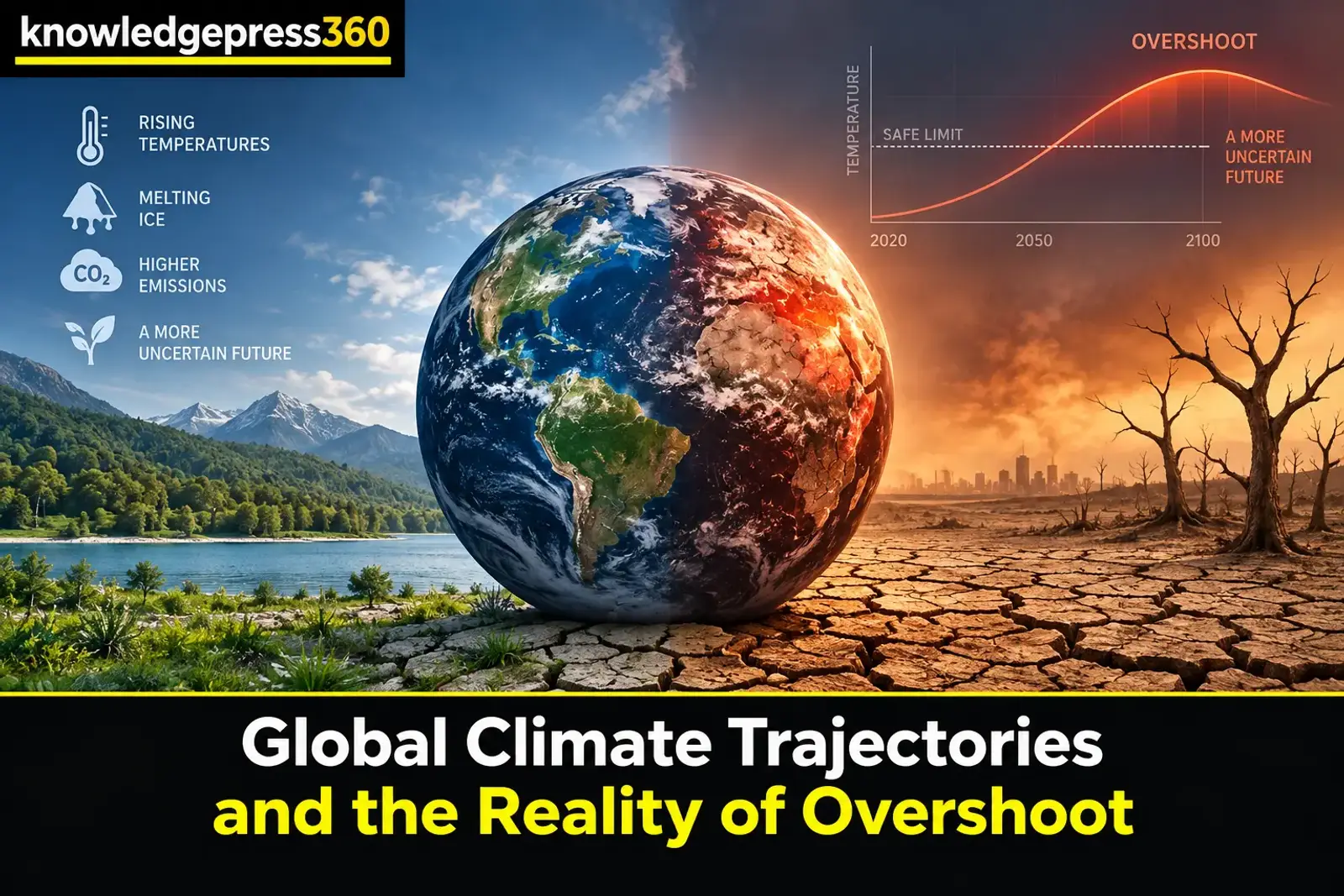
International climate science has reached a sobering juncture as new empirical assessments underscore the growing probability that global average temperatures will temporarily breach the vital threshold established by international agreements. For decades, policymakers and scientists have centred their mitigation efforts on keeping long-term warming below 1.5°C relative to pre-industrial levels. However, recent authoritative findings indicate that historical emissions and current trajectories make an overshoot scenario increasingly difficult to avoid. This development carries profound implications for ecosystems, human health, and economic stability across vulnerable regions worldwide, signalling that the global community must simultaneously prepare for heightened environmental stress while redoubling mitigation efforts.
United Nations Warning on Overshoot
On September 2, 2026, the United Nations Environment Programme released a comprehensive evaluation titled Limiting Overshoot, which articulates a stark reality for the coming decade. The report warns that long-term global warming is likely to exceed the Paris Agreement target within the next few years, creating a period where temperatures remain elevated above safe limits for an extended duration before potentially dropping back down. Even under the most optimistic mitigation scenarios modelled within the UNEP framework, global temperatures are projected to peak at approximately 1.8°C above pre-industrial baselines. More pessimistic pathways suggest that emissions trajectories could push planetary warming well beyond 2°C, triggering compounded environmental feedbacks.
This temporary or extended breach is not merely an academic concern but an active driver of atmospheric disruption. Climate change has already doubled the frequency of global heatwaves between 2024 and 2025, while unleashing severe droughts, intensifying floods, and deepening water shortages across vulnerable continents such as Africa. Developing regions and Small Island Developing States find themselves on the front lines of these crises. Despite contributing a minimal fraction of historical greenhouse gas emissions, these nations face disproportionate devastation to agricultural yields, public infrastructure, and local livelihoods.
Early Warnings and Regional Vulnerability
Recognising the urgent need to protect exposed populations from intensifying extremes, international bodies have stepped up efforts to bolster local resilience. On September 7, 2026, the World Meteorological Organization issued the Addis Ababa Call to Action, focusing squarely on the imperative to accelerate multi-hazard early warning systems across Africa. Framed under the overarching Early Warnings for All initiative, the declaration emphasises that no community should face a predictable climate hazard without the institutional capacity to anticipate danger, receive timely alerts, and act before lives are lost.
Despite notable advancements in meteorological monitoring over recent years, significant gaps persist across the continent. Least Developed Countries, fragile states, and isolated island communities frequently lack robust observation networks, sustainable financial backing, and reliable last-mile communication channels. Furthermore, institutional fragmentation often hampers coordination between national meteorological agencies and local authorities, leaving millions of urban and rural residents exposed to fast-moving weather events. Strengthening these foundational observation and forecasting structures remains an indispensable prerequisite for minimising human loss as global temperatures rise.
Policy Challenges and Future Horizons
Addressing the climate overshoot era requires navigating complex policy dimensions and acknowledging persistent scientific uncertainties. Researchers continue to debate the exact peak temperature and duration of the impending overshoot, variables that depend heavily on the speed of future decarbonisation and the deployment of atmospheric carbon dioxide removal technologies. Furthermore, the extent to which international climate financing and domestic development policies can be effectively aligned remains a central point of contention among global stakeholders.
As the international community looks toward upcoming climate summits, the focus is shifting from theoretical target-setting to measurable implementation. Observers will be closely watching how financial pledges materialise on the ground and whether national governments can scale up domestic budgets for disaster preparedness. Ultimately, while exceeding the 1.5°C threshold appears increasingly difficult to prevent, the ultimate magnitude and duration of the overshoot remain malleable through decisive, coordinated global action across all participating nations.