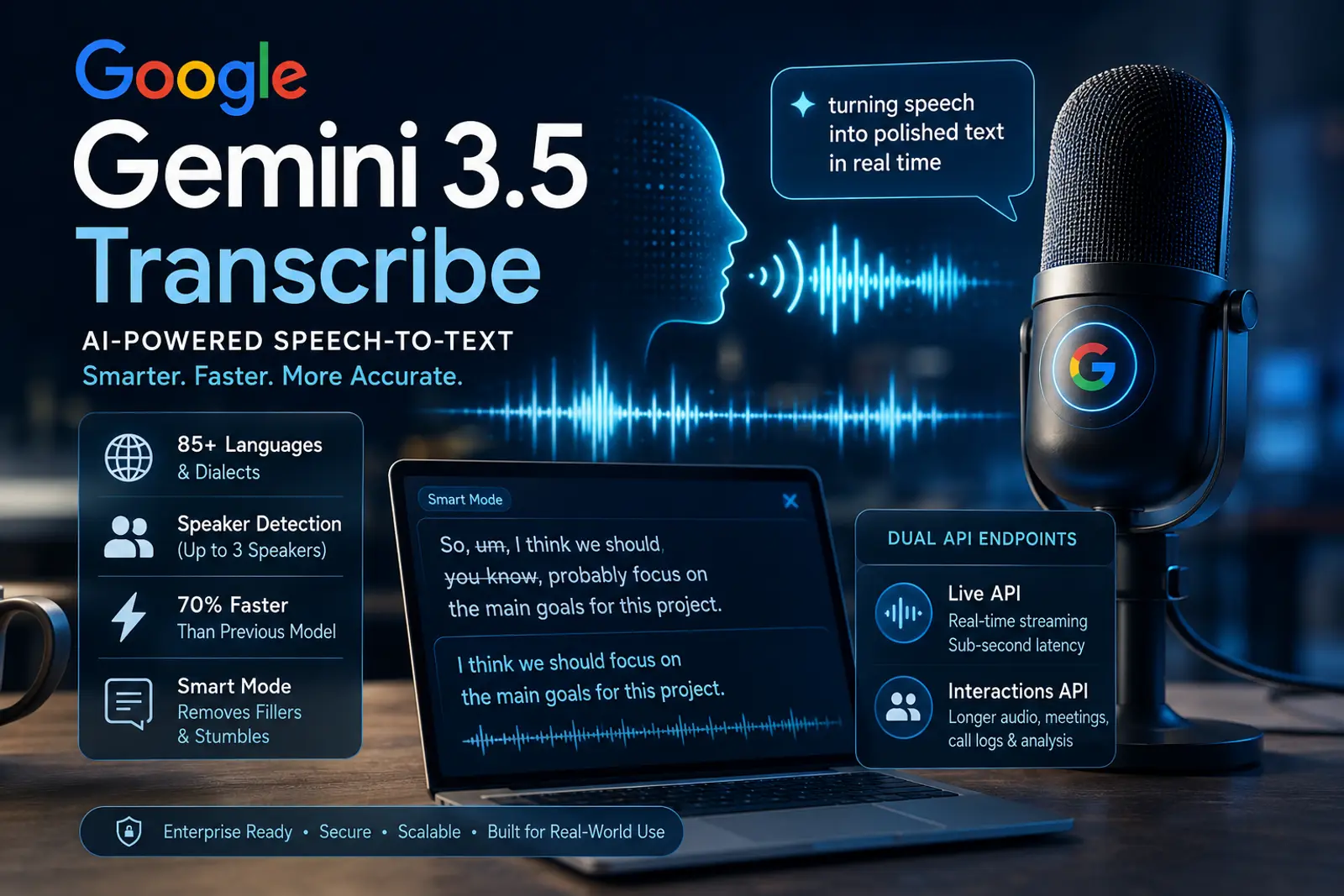
Google has officially introduced Gemini 3.5 Transcribe, a major new artificial intelligence model designed to transform how voice input is processed across real-time interfaces and pre-recorded audio archives. Arriving as part of the broader 3.5 branch expansion and succeeding the previous Chirp 3 speech-to-text engine, the new technology addresses long-standing frustrations with voice dictation by actively filtering out verbal stumbles, eliminating filler words, and outputting polished text. As conversational user interfaces and voice-driven developer tools become central to modern computing, this release marks a significant practical shift toward seamless audio integration across consumer devices and enterprise platforms.
Architecture and Performance Benchmarks of Gemini 3.5 Transcribe
The technological leap behind Gemini 3.5 Transcribe is rooted in significant gains in both processing speed and transcription accuracy. According to data cited by Google from independent benchmarking firm Artificial Analysis, the model achieves an average Word Error Rate of 4.0 percent for streaming applications and an even lower 2.6 percent for non-streaming audio processing. When evaluated on the rigorous FLEURS benchmark, the model records a Word Error Rate of 5.50 percent in streaming evaluations and 5.04 percent for non-streaming tasks. Furthermore, Google reports that the elapsed time from initial voice input to final transcribed text is roughly 70 percent faster than its predecessor, with live-speech error rates dropping to 5.5 percent.
Designed to accommodate a diverse global user base, the model natively supports more than 85 languages and regional dialects. It incorporates advanced linguistic capabilities such as automatic language detection, mid-sentence code-switching, and the identification of up to three distinct speakers in pre-recorded files, complete with word-level timestamps. Developers can also leverage custom vocabulary biasing to ensure that specialised industry jargon, acronyms, and proper nouns are transcribed correctly.
Ecosystem Integration and Dual API Deployment Options
To facilitate integration across diverse software environments, Google has deployed the technology through two distinct developer endpoints, each tailored to specific operational requirements. The Live API is engineered for continuous bidirectional streaming with sub-second latency, making it ideal for real-time voice agents and interactive assistants. Conversely, the Interactions API is optimised for longer audio files, meeting recordings, and call log analysis, providing robust speaker attribution and custom vocabulary support for up to 1,000 specific terms. Within Google's own ecosystem, the model is already powering features such as the Gboard Rambler tool on Pixel 11 devices in select regions, operating within Google Antigravity, supporting voice commands in the Gemini macOS app, and enabling direct dictation into web fields inside the Chrome browser.
Both developer endpoints offer two distinct processing modalities to suit varying workflow needs. The default verbatim mode preserves every spoken utterance, capturing exact verbal habits and stumbles for precise records. Alternatively, the smart mode actively intercepts conversational fillers such as ums and uhs, smoothing out self-corrections inline to generate clean, readable text without requiring manual cleanup from the user.
Technical Constraints and Enterprise Compliance Challenges
Despite its impressive technical specifications, the rollout of Gemini 3.5 Transcribe introduces several constraints and compliance considerations that organisations must navigate. Because the software is deployed exclusively as a managed service without open weights or self-hosted pathways, institutions must rely entirely on Google's infrastructure. Technical limitations also apply to the developer interfaces; for instance, the Live API caps continuous streaming sessions at ten minutes and omits support for speaker diarization and word-level timestamps. Similarly, organisations utilising the Interactions API cannot combine the smart mode with word timestamps or speaker diarization, forcing development teams to choose between an auditable transcript and a stylistically polished summary.
Observers have also highlighted potential compliance challenges associated with the smart mode modification of spoken audio. While stripping out verbal fillers enhances readability for casual notes and drafts, altering the original wording of a statement introduces legal and accuracy concerns in formal, regulated, or evidentiary contexts. Because the developer and enterprise tracks are currently released in public preview, production-level deployments require careful auditing and validation.
Future Milestones and Independent Production Evaluations
As Gemini 3.5 Transcribe continues its public preview phase across Google AI Studio and the Enterprise Agent Platform, stakeholders should monitor several key developments. Immediate priorities include incoming independent performance evaluations across all 85 supported languages to corroborate vendor-reported benchmarks outside of controlled testing environments. Developers will also be watching for updates regarding managed-service pricing structures, production-level stability limits, and potential architectural adjustments that might lift the ten-minute streaming cap or allow simultaneous smart-mode processing with speaker diarization. Observing how enterprise adopters manage the trade-offs between automated text polish and verbatim legal accuracy will ultimately determine the long-term viability of AI-driven dictation in professional workflows.