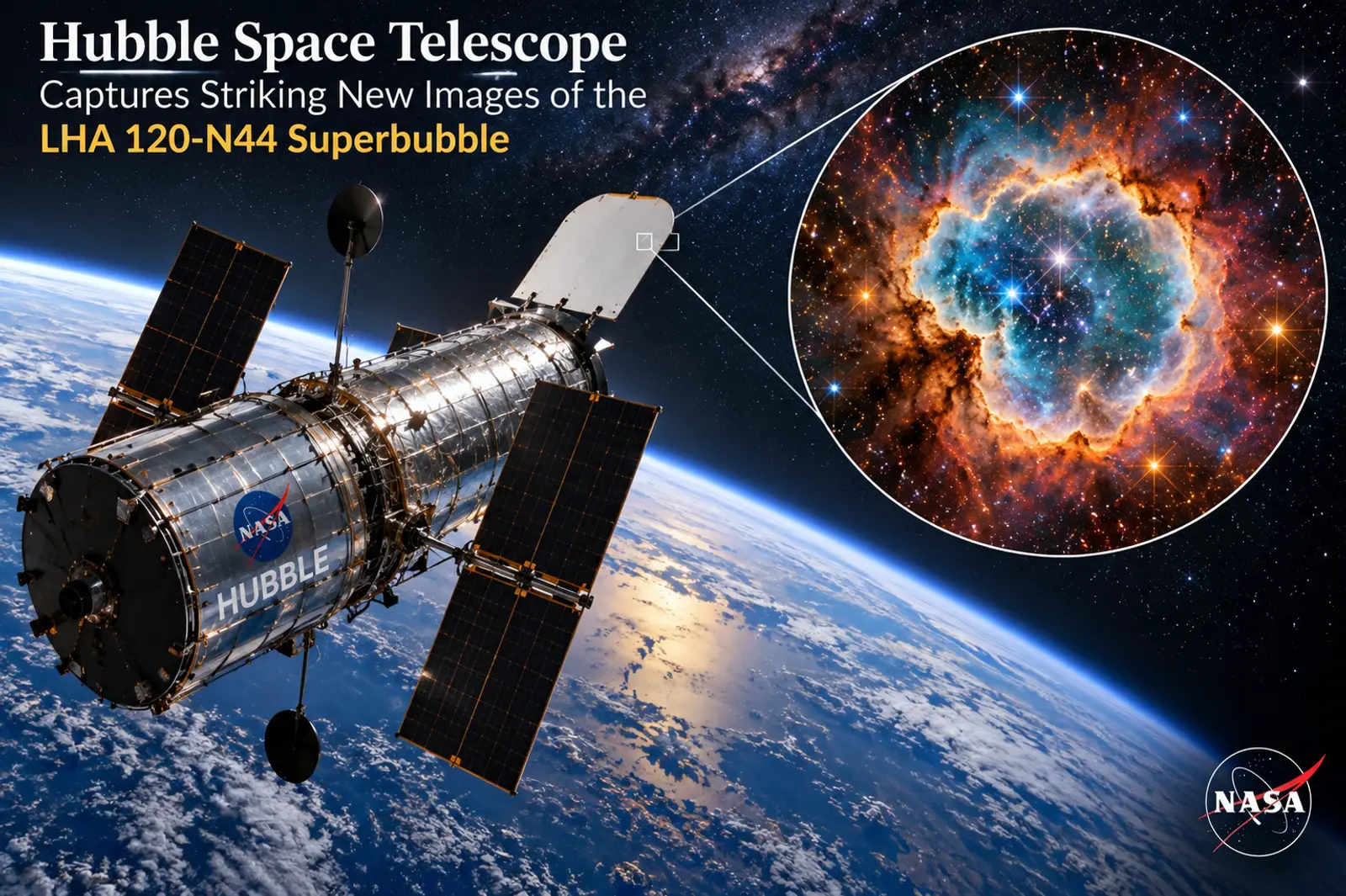
The Hubble Space Telescope has once again opened a window into the cosmos, returning imagery of a massive cosmic phenomenon located beyond our Milky Way. Astronomers have turned their attention toward a nebula superbubble known as LHA 120-N44, or simply N44, situated within the Large Magellanic Cloud. This capture showcases the details of deep space while providing researchers with a laboratory to examine the life cycles of stars. By peering into this distant stellar nursery, scientists aim to answer questions regarding how massive star clusters shape their surrounding environments and drive galactic evolution.
Unveiling the Vast Cosmic Void in the Dorado Constellation
Located approximately 160,000 light-years away from Earth, the N44 complex resides within the southern constellation of Dorado, inside one of our closest galactic neighbours. The feature of the released imagery is a central void that measures around 210 by 140 light-years across, nested within a broader glowing nebula complex spanning roughly 1,000 light-years. This emission nebula glows due to the ionization and subsequent cooling of hydrogen gas, which is energized by radiation from massive stars situated nearby.
Astrophysicists explain that this immense cavity was likely carved out by a combination of powerful stellar winds and explosive supernovae generated by massive stars residing at its core. These energetic processes effectively blew away the surrounding primordial gas, sweeping material outward to form a dense and dusty outer shell. The resulting perimeter now acts as a compressed boundary where new generations of stars are actively being forged, creating a contrast between the hollowed-out interior and the stellar nurseries lining the edges.
Surveying Hundreds of Thousands of Stars Within N44
Beyond the visual impact of the central cavity, the observational data gathered by Hubble represents a census of stellar demography. Researchers examining the cluster have catalogued nearly 500,000 stars situated in and around N44. Among this population, astronomers have identified approximately 30,000 pre-main-sequence stars, representing celestial bodies that have not yet ignited nuclear fusion within their dense cores.
This high concentration of developing stars transforms N44 into a site for studying stellar formation and evolution. The interplay between the deaths of older, massive stars and the birth of younger stellar neighbours illustrates a cycle of renewal. The compressed gas shell serves as a ground where gravitational forces routinely overcome internal pressures, forcing cold gas clouds to collapse into dense knots that will eventually spark into fully fledged stars.
Unresolved Mysteries in Stellar Evolution and Age Variance
Despite the data provided by high-resolution space telescope observations, uncertainties remain regarding the precise timeline and mechanics governing star formation within superbubbles. Astronomers continue to examine the exact duration and physical mechanisms that occur between the initial collapse of cold gas clouds and the moment nuclear fusion officially ignites in newborn stars. Pinpointing these critical transition periods remains essential for accurate modelling of galactic ecosystems.
Furthermore, researchers are studying a potential five-million-year age difference previously identified between stars residing within the interior of the superbubble and those situated along its rim. Determining whether these stellar populations formed in distinct epochs or through a continuous wave of star formation remains a challenge. Resolving these discrepancies will require rigorous cross-comparisons with data from newer astronomical facilities, ensuring that the physical history of N44 is understood in detail.
Future Observations and Cross-Facility Research Horizons
As scholarly investigations into LHA 120-N44 progress, the astronomical community is preparing for the next phase of collaborative deep-space exploration. Observers are watching for upcoming studies that aim to refine current evolutionary models of massive star-forming regions using expanded archival data. These efforts will increasingly benefit from cross-comparisons involving next-generation instruments such as the Nancy Grace Roman Space Telescope, which is designed to survey wide fields of view with infrared sensitivity.
By combining Hubble's ultraviolet and optical vision with broader infrared surveys, astronomers hope to pierce through the thick dust lanes of complexes like N44 to uncover fainter pre-main-sequence stars. This multi-facility approach will bridge gaps in our current understanding of stellar lifecycles, shedding light on the feedback loops that govern star birth and destruction across the universe.