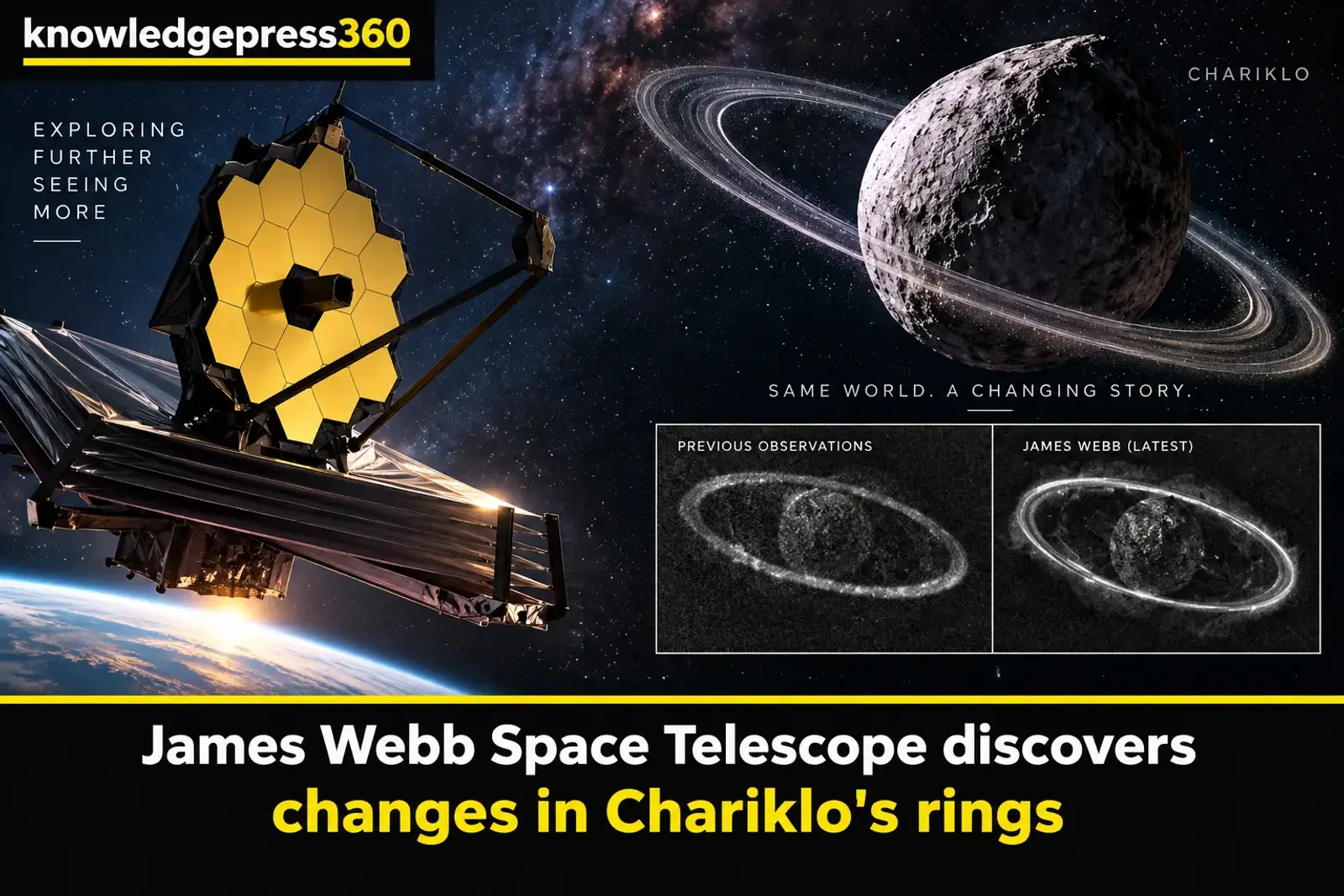
Recent observations conducted with the James Webb Space Telescope have revealed unexpected transformations within the ring system of Chariklo, a diminutive celestial body orbiting the outer reaches of the solar system. Measuring approximately 155 to 160 miles in diameter, Chariklo belongs to the Centaur family of asteroids and travels through the expanse between Saturn and Uranus. When astronomers first identified a pair of thin rings encircling the asteroid back in 2013 via ground-based stellar occultation, the discovery challenged long-held assumptions that such intricate structures were exclusive to giant gas planets. Now, advanced infrared capabilities have demonstrated that these rings are far from static, initiating a fresh wave of inquiry into the fundamental physics that govern small body ring systems across the solar system. Understanding these shifts matters because it forces researchers to re-evaluate how tiny bodies accumulate, retain, and manage material over astronomical timescales without the gravitational dominance of a major planet.
Unveiling ring opacity shifts
The investigation into Chariklo's evolving morphology began in October 2022 when a research collective from the Institute of Astrophysics of Andalusia deployed the space telescope to monitor a stellar occultation event. By measuring the precise dip in starlight as the asteroid passed in front of a distant star, the science team captured high-resolution data regarding the density and distribution of the surrounding material. Comparing these fresh metrics with historical observations gathered over the preceding decade exposed a striking dichotomy within the ring architecture. The inner ring displayed a significantly higher opacity than observed previously, indicating a denser accumulation or tighter compaction of particles. Conversely, the outer ring exhibited a measurable reduction in opacity, suggesting that material had either thinned out or dispersed over time. This simultaneous, opposite behavior across two closely spaced rings upended earlier models that assumed small body rings maintained steady equilibrium.
Technical precision behind observations
Achieving such high-fidelity data acquisition required an extraordinary orchestration of spaceflight technology and astronomical positioning. The observations relied heavily upon the Near-Infrared Camera instrument aboard the space observatory, combined with meticulous orbital tracking of the asteroid. Furthermore, target star positioning was refined using positional datasets from the European Space Agency spacecraft, while the telescope itself maintained stable station-keeping maneuvers near the Lagrange point located roughly one million miles beyond Earth. During the occultation study, Chariklo cruised at approximately 5,600 miles per hour relative to the observatory. This relatively slow relative velocity provided the crucial window needed to record the faint shadows cast by the thin rings with remarkable clarity. Without this unique convergence of advanced instrumentation and precise astrometry, tracking such subtle structural adjustments across billions of miles would have remained impossible.
Persistent mysteries in ring evolution
Despite the unprecedented clarity provided by modern instrumentation, the exact physical drivers behind Chariklo's fluctuating opacity remain deeply puzzling. Researchers acknowledge that significant uncertainties persist regarding the specific mechanisms causing the opposite trajectories of the inner and outer rings. Whether these transformations stem from gravitational resonances, impacts from microscopic debris, or internal structural adjustments of the parent asteroid is still a matter of intense debate. Furthermore, the broader evolutionary history of Centaur ring systems remains enigmatic, leaving scientists without a complete framework to explain how such delicate formations persist in volatile orbital environments. The absence of definitive answers highlights the complexity of planetary ring dynamics and underscores the necessity of continued surveillance to untangle the competing forces at play.
Future milestones and ongoing tracking
As the scientific community digests these findings, attention turns toward upcoming observational campaigns and extended monitoring efforts. Researchers plan to utilize future occultation opportunities to gather additional datasets, seeking to determine whether the observed opacity shifts are part of a cyclical phenomenon, short-term disruptions, or long-term evolutionary trends. Continued peer-reviewed evaluations of these ongoing observations will be essential in refining dynamical models of small solar system bodies. As astronomers secure more transit data in the coming years, they hope to resolve the lingering ambiguities surrounding Chariklo and clarify whether changing rings are a common feature across the broader Centaur population.