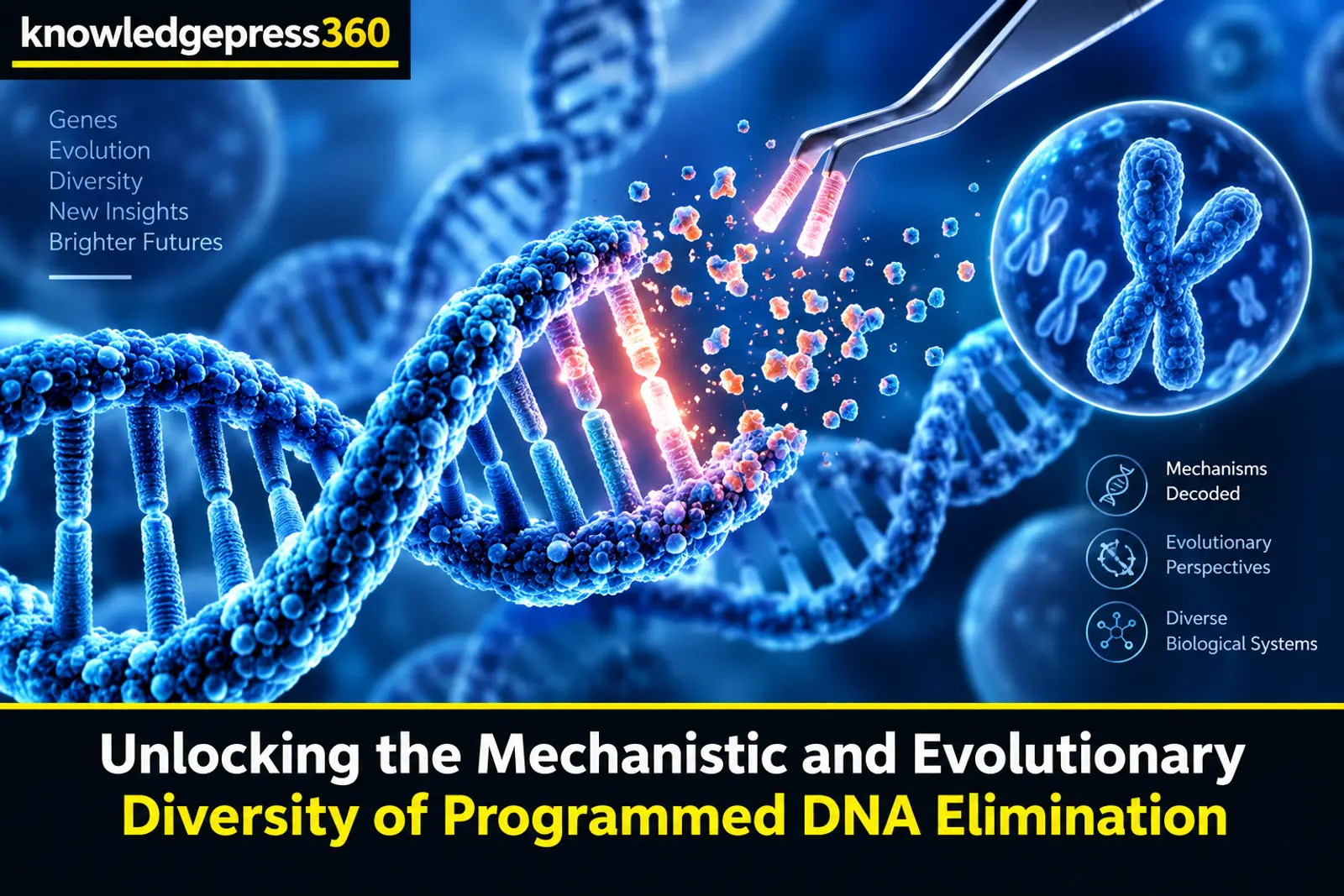
For decades, the central dogma of genetics rested upon the assumption that every somatic cell within a multicellular organism carries an identical copy of the genetic code. Recent scientific literature has disrupted this paradigm by showcasing the vast mechanistic and evolutionary diversity of programmed DNA elimination. Rather than a rare genetic anomaly, targeted and regulated genome downsizing is now recognized as a widespread, highly dynamic biological process operating across numerous eukaryotic lineages. From unicellular ciliates to complex vertebrates, developmental genome tailoring serves as a mechanism of evolutionary adaptation, gene regulation, and species diversification. Understanding these natural genetic engineering strategies provides insights into chromosome biology, transposable element control, and the functional balance between gene loss and retention.
Programmed Chromosome Fragmentation and Genome Downsizing Across Diverse Eukaryotes
Programmed DNA elimination manifests through an extraordinary array of varied mechanisms across the eukaryotic tree of life. Historical foundations laid by pioneering cytogeneticists like Theodor Boveri have evolved into high-resolution analyses that reveal how diverse organisms discard portions of their genomes during normal development. In ciliated protozoa, this process involves intricate small-RNA-guided histone modifications and somatic genome elimination, restructuring the nuclear architecture between germline and somatic lineages. In various metazoans, specialized chromosomal fragmentation, paternal genome elimination, and non-random chromosome segregation ensure that specific cell types shed unneeded genetic cargo. This widespread distribution indicates that large-scale DNA shedding is a regulated developmental strategy employed by disparate taxa to manage gene expression and genomic integrity.
Oscheius tipulae and Songbird Germline-Restricted Chromosomes as Genomic Models
Detailed investigations into specific model organisms have begun to illuminate the molecular signatures that govern targeted DNA loss. Research utilising the nematode Oscheius tipulae has established a genetic model for metazoan programmed DNA elimination, providing evidence that a degenerate palindromic motif is essential for initiating DNA loss during development. Simultaneously, avian genomics has uncovered phenomena in songbirds, where germline-restricted chromosomes drive rapid genomic innovation and massive gene turnover. Recent genomic sequencing and preprint studies tracking songbird evolution indicate that these specialized chromosomes are sites of genetic novelty. Similarly, sequence-level analyses of black-winged fungus gnats demonstrate that gene-rich germline-restricted chromosomes likely originated through ancient whole-genome introgression and hybridization events between distinct fly lineages.
Persistent Mechanistic Uncertainties and Evolutionary Debates in Genome Downsizing
Despite rapid advancements driven by modern sequencing technologies, significant knowledge gaps and active debates persist within the scientific community. Researchers continue to grapple with uncertainties surrounding the precise protein machinery and molecular components responsible for driving DNA recognition and excision in newly emerging metazoan models. Furthermore, the exact selective advantages, evolutionary trajectories, and ultimate functional burdens associated with maintaining germline-restricted chromosomes in vertebrates and insects remain debated. While genomic data illustrate massive gene turnover and structural innovation, the universal regulatory networks that trigger programmed elimination events across broad phylogenetic distances have yet to be fully mapped. Investigators must reconcile how these diverse evolutionary paths converge on functional genome downsizing without compromising organismal viability.
Future Comparative Genomics and Unifying Frameworks in Chromosome Biology
Looking ahead, the field is poised for a significant synthesis as researchers move beyond isolated model systems to broader comparative analyses. Observers should watch closely for forthcoming peer-reviewed outcomes from ongoing preprint studies examining avian germline-restricted chromosome evolution, alongside expanded genomic sequencing across non-model invertebrates and vertebrates. These upcoming investigations will be crucial in determining whether a unified mechanistic framework governs eukaryotic genome downsizing or if independent lineages evolved distinct toolkits to achieve the same genomic outcome. By bridging these knowledge gaps, science will gain a deeper appreciation of how genomes dynamically shrink, adapt, and innovate across evolutionary time.