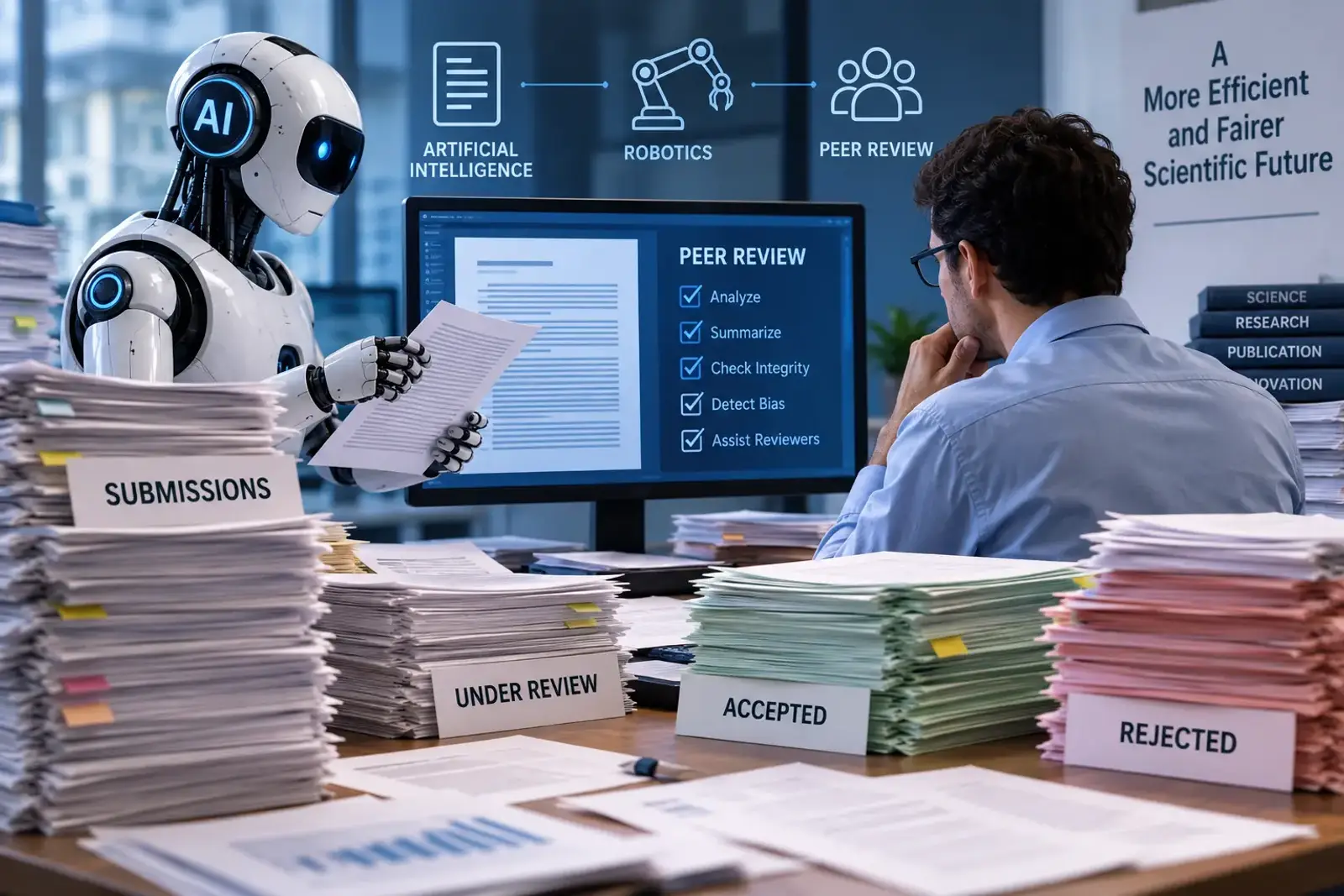
The global academic publishing ecosystem is facing an unprecedented bottleneck, driven by an exponential explosion in manuscript submissions that threatens the foundational integrity of scientific validation. As overworked researchers struggle to keep pace with an ever-expanding library of literature, the scientific community is increasingly turning to artificial intelligence and large language models for relief. While these advanced digital tools offer remarkable potential to streamline the grueling mechanical tasks of literature reviews, their integration into academic publishing introduces complex risks. From deceptive hallucinations to a manufactured sense of scientific understanding, relying on automated systems without strict human oversight presents profound challenges for the future of scholarly research.
Surviving the Paper Deluge at the International Conference on Robotics and Automation
The compounding strains of this academic overload were brought into sharp focus during a panel titled Surviving the Paper Deluge, held at the IEEE International Conference on Robotics and Automation. Chaired by Aude Billard, the discussion addressed the staggering volume of new literature flooding major publishing venues within the IEEE Robotics and Automation Society. According to data presented at the event, publication numbers have surged along a roughly exponential curve that began around 2017. Current estimates suggest that approximately 70,000 papers containing the word robotics were published in 2025 alone.
This unrelenting deluge creates a distinct vulnerability for robotics, a discipline that depends fundamentally on cross-disciplinary integration. Unlike fields where extreme specialization serves as a viable survival strategy, robotics requires the seamless synthesis of perception, control, manipulation, learning, hardware, interaction, safety, and deployment. When the volume of new research outpaces human reading capacity, scholars risk retreating into narrow silos, potentially fracturing the holistic nature of the field and obscuring critical connections between disparate domains.
Automating Literature Reviews and Evaluating Research Yield in Modern Publishing
To measure the actual depth of this publishing boom, researchers have begun conducting rigorous audits of contemporary output. A case study presented by Kunpeng Yao, funded by the IEEE RAS Science and Technology Watch Board, evaluated a targeted set of 2024 learning-from-demonstration papers. Out of 347 screened studies, the evaluation revealed that only about 20 percent, amounting to 69 papers, made notable and substantive contributions to the state of the art. The vast majority of submitted literature offered incremental, repetitive, or insufficiently rigorous advancements, highlighting how sheer volume frequently dilutes genuine scientific progress.
In response to this administrative burden, researchers are exploring large language models to assist with the mechanics of literature synthesis. When deployed effectively, these tools can rapidly handle search, retrieval, clustering, table generation, and conceptual mapping. Tasks that traditionally required weeks or months of tedious manual cataloguing can now be executed in hours. For early-career researchers attempting to navigate densely populated fields, this technological assistance lowers the barrier to entry and helps establish initial footholds in complex research landscapes.
Understanding First, Second, and Third-Order Hallucinations in Automated Systems
Despite their undeniable utility in managing administrative and organizational workflows, large language models carry severe pitfalls that make them dangerous arbiters of scientific quality. Experts warn that automated tools are notoriously susceptible to hallucinations, which manifest across multiple distinct layers within academic contexts. First-order hallucinations involve the generation of entirely fabricated references or non-existent citations that look deceptively authentic.
More insidious are second-order hallucinations, where an automated system references a real, verifiable paper but fundamentally mischaracterises its methods or findings. Perhaps most concerning are third-order hallucinations, wherein the algorithm invents false commonalities and nonexistent thematic bridges across entirely unrelated studies. These sophisticated errors do not merely produce fake citations; they foster a dangerous illusion of comprehension, leading automated systems and unwary reviewers toward a state of fake understanding that undermines rigorous peer critique.
Safeguarding Academic Integrity and Balancing Automation in Scholarly Publishing
As journals, funding bodies, and academic societies grapple with overloaded systems, the scientific community must carefully delineate the boundaries of automation. While algorithms can successfully accelerate mechanical organization and text summarization, substituting human judgment with artificial intelligence in core evaluation processes risks compromising the reliability of scientific validation. Observers are closely watching whether emerging technical safeguards, stricter validation protocols, and higher thresholds for originality can successfully balance the efficiency of automation with the irreplaceable standards of human academic integrity.