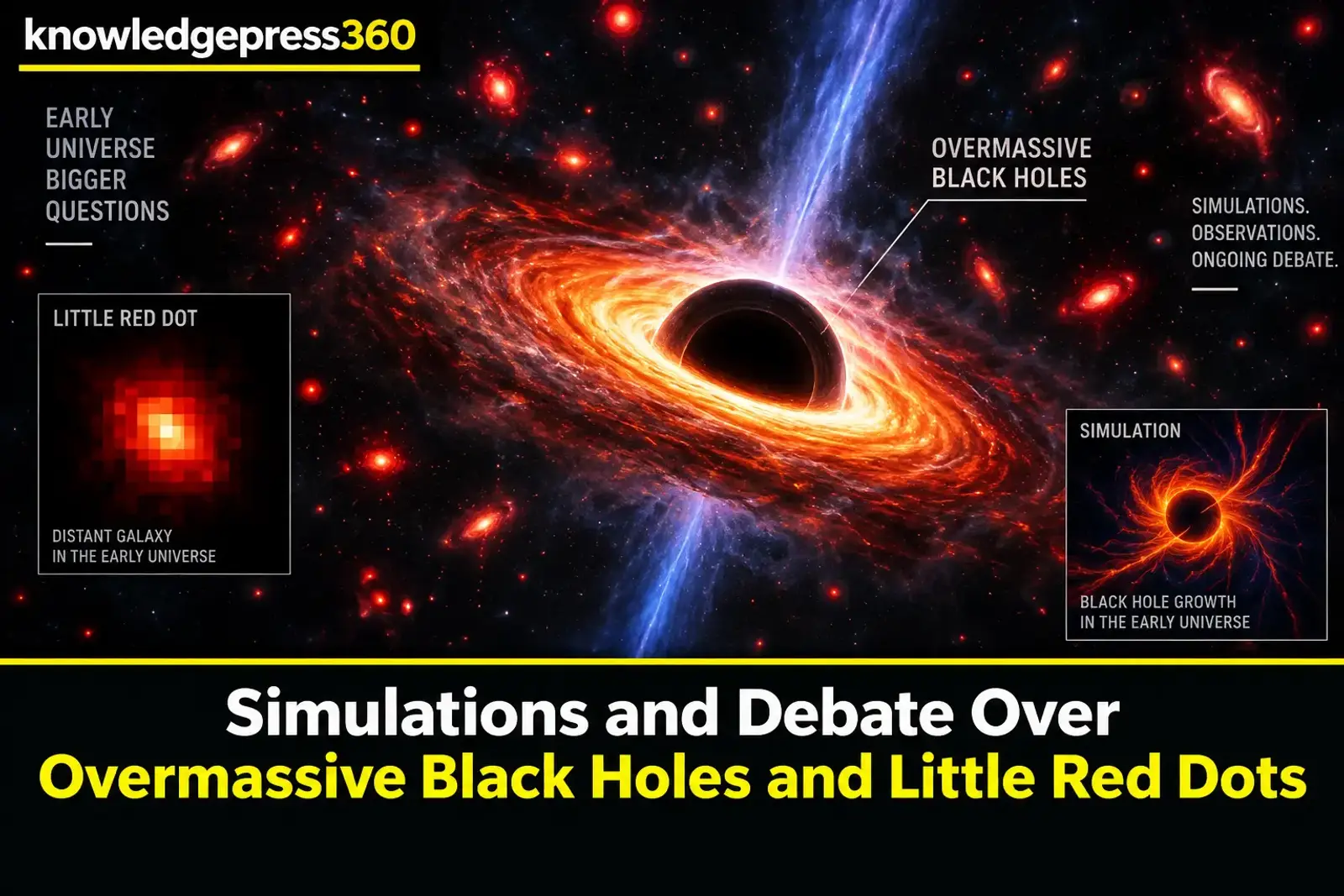
Recent discoveries made possible by the James Webb Space Telescope have radically reshaped our understanding of cosmic history, forcing astrophysicists to rethink how supermassive black holes formed in the early universe. Among the most puzzling discoveries are compact, intensely red sources scattered throughout high-redshift space, which exhibit blinding infrared spectra and luminosities that rival entire galaxies. Their inferred masses appear far too large for standard cosmological timelines, challenging long-held assumptions about stellar and galactic evolution. However, groundbreaking radiation-hydrodynamic simulations published in September 2026 offer a compelling theoretical framework, suggesting that these anomalous celestial bodies can be accounted for by natural mechanisms in the early cosmos. As researchers continue to debate whether these sources represent rapid black hole seed formation or an entirely unique class of astronomical phenomena, the scientific community stands on the brink of resolving one of modern astrophysics' most persistent enigmas. Understanding these objects is essential for mapping the evolutionary trajectory of the universe's most massive gravitational titans.
Unveiling Little Red Dots With JWST
Ever since the James Webb Space Telescope began transmitting its deepest infrared imagery of the early universe, astronomers have been confronted by a population of unusual celestial objects [1, 2]. Dubbed little red dots due to their compact angular dimensions and crimson spectral signatures, these sources shine with astonishing brilliance across vast cosmological distances [1, 2]. Initial analyses revealed that their calculated black hole masses vastly exceeded local scaling relations, creating a profound theoretical crisis that led some investigators to label them universe breakers [1]. These compact configurations initially seemed to defy standard models of cosmic growth, as conventional timelines could not easily account for how such massive structures could emerge less than a billion years after the Big Bang [1, 2]. The sheer abundance of these dots in early imaging fields confirmed they were not mere statistical anomalies but a prominent population demanding rigorous physical explanation [2].
Simulating Heavy Black Hole Seeds
A major theoretical breakthrough arrived when researchers published advanced cosmological radiation-hydrodynamic simulations demonstrating how heavy black hole seeds can form naturally in the early universe [1]. These models reveal that in overdense protocluster regions exposed to intense far-ultraviolet radiation from nearby star-forming galaxies, early star formation is effectively suppressed [1]. Consequently, massive gas reservoirs accumulate before collapsing directly into enormous seeds of approximately one million solar masses [1]. These seeds then undergo brief yet intense phases of rapid growth, expanding to match the observational characteristics of little red dots by redshift eight to ten [1]. By capturing these complex physical interactions in three dimensions, the simulations successfully reproduce the distinctive Balmer features and red continua observed by space telescopes, bridging the gap between theoretical birth models and empirical data [1].
Observational Bias and Alternative Theories
Despite the success of recent hydrodynamic models, the broader scientific community remains intensely divided regarding the exact physical nature of these enigmatic sources [2]. Some independent research groups have proposed radical alternative configurations, suggesting that certain observed pairs might represent an entirely new category of object known as a black hole star [2]. Meanwhile, investigations into lower-redshift spiral analogs, such as the galaxy nicknamed the Saguaro, indicate that observational bias plays a significant role in how these distant systems appear to modern instruments [4]. When researchers synthetically shifted the Saguaro to a higher simulated redshift, its surrounding galactic structure faded away, leaving only a bright, central source resembling a classic little red dot [4]. This experiment highlights the ongoing difficulty in decoupling intrinsic physical properties from limitations in current telescopic resolution and sensitivity [4].
Next Steps in Astrophysical Research
Resolving the ongoing debate surrounding these overmassive black holes and their red counterparts will require a concerted international effort combining advanced computational modeling with deeper observational campaigns [1, 2]. Astronomers are currently planning expanded spectroscopic surveys using the James Webb Space Telescope to target faint high-redshift candidates with unprecedented precision [1, 2]. At the same time, theoreticians are refining their radiation-hydrodynamic simulations to account for a broader range of environmental conditions and feedback mechanisms within early protoclusters [1]. As archival data from both space-based and ground-based facilities are meticulously re-evaluated, the coming years will likely determine whether little red dots signify heavy seed formation pathways, transient accretion spikes, or a wholly undiscovered frontier in fundamental astrophysics [1, 2].