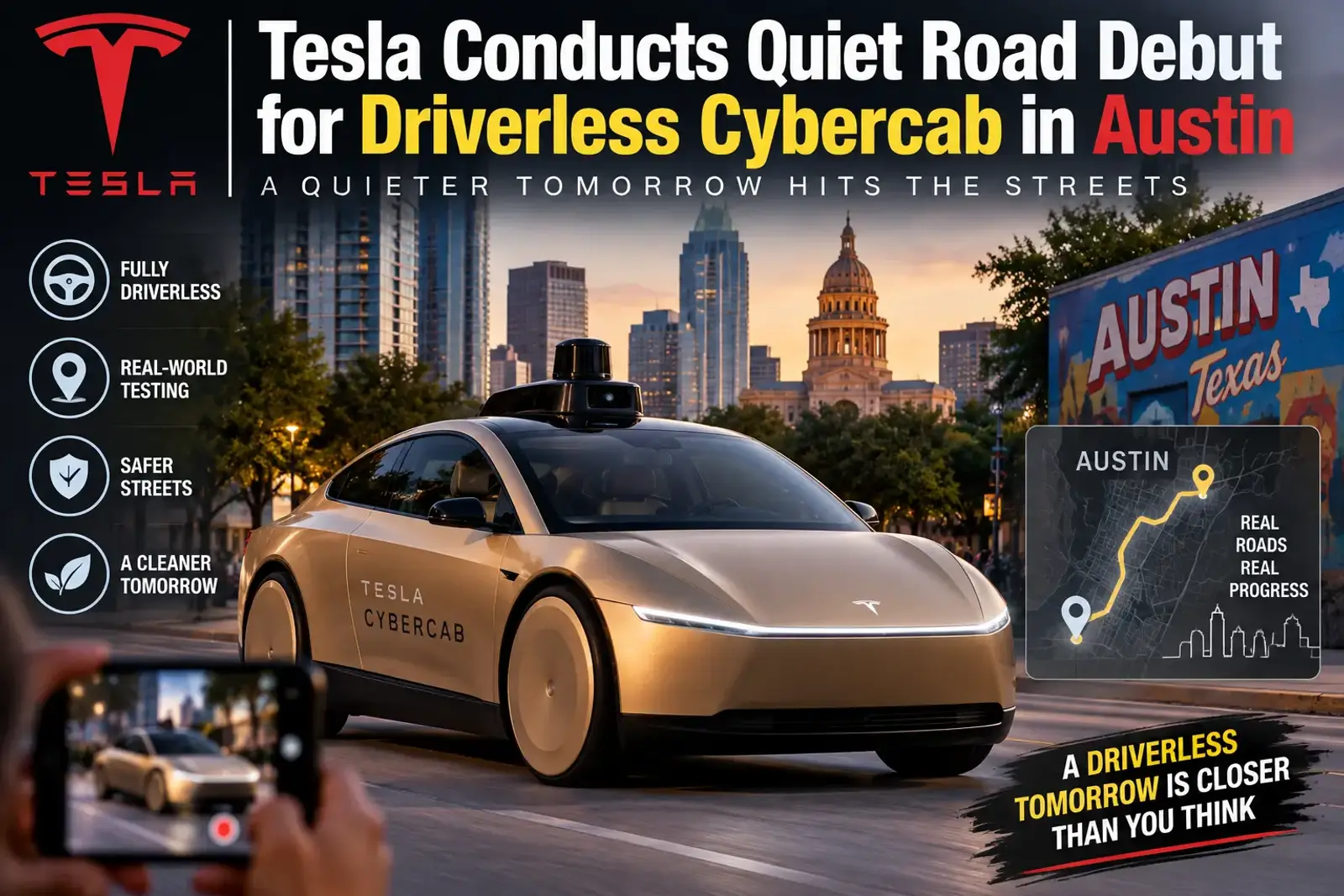
Tesla has completed the initial road rollout of its long-awaited driverless Cybercab, choosing an unusually restrained approach for a company accustomed to high-octane stadium spectacles. Rather than utilizing a grand public showcase with CEO Elon Musk commanding the stage, the firm hosted a tightly controlled, closed-door gathering in Austin, Texas. Traditional journalists were excluded from the venue, no public livestream was broadcast to the millions of global followers, and invited guests were bound by strict non-disclosure agreements. This muted strategy highlights the immense pressure facing the manufacturer as it attempts to transition from a conventional carmaker into a dominant artificial intelligence and robotics enterprise.
Closed-Door Austin Event And Regulatory Registration In Texas
The restricted debut took place in Austin, where attendees consisting largely of prominent online content creators experienced early rides in the autonomous vehicles after information embargoes were lifted. According to official records from the Texas Department of Motor Vehicles, forty-five Cybercabs are currently registered to operate on the state's robotaxi network. The vehicle itself represents a radical departure from traditional automobile design. It is a lightweight, matte-gold two-seater completely devoid of a steering wheel, foot pedals, and conventional rearview mirrors. Instead of relying on radar or lidar sensing arrays, the cabin-forward machine navigates using an arrangement of eight exterior cameras, driven by a front-mounted 219-horsepower motor paired with a 48-kilowatt-hour battery that brings its total curb weight to 3,113 pounds.
Autonomous Fleet Milestones And Competitive Pressures
During the Austin presentations, Tesla artificial intelligence software head Ashok Elluswamy announced that company vehicles had collectively accumulated one million driverless miles. This expansion of autonomous operations marks a significant operational step forward, building on previous trials that utilized modified Model Y sport utility vehicles across parts of Texas and Florida. Yet, the commercial deployment arrives amid intense industry competition and strategic hurdles. Rivals such as Alphabet-owned Waymo have already deployed thousands of autonomous vehicles across multiple metropolitan areas, scaling operations far more rapidly than Tesla. Furthermore, while Texas transportation laws enacted in 2017 offer a welcoming regulatory environment by stripping local municipalities of restrictive powers, states like California continue to mandate human safety drivers, severely limiting testing capabilities in those jurisdictions.
Unresolved Commercial Ambiguities And Fleet Scaling Limits
Despite the physical presence of the registered fleet on Texan asphalt, notable questions persist regarding the broader commercial viability and public rollout timeline. Observers note that exact figures concerning how many of the forty-five registered Cybercabs have been immediately assigned to active commercial service remain unclear. Furthermore, Tesla has yet to announce definitive retail pricing structures for everyday consumers or establish a concrete launch date for personal ownership. Safety and accessibility protocols are already being implemented through a newly established robotaxi website, which explicitly bans children under the age of thirteen from riding unaccompanied, but broader logistical scaling remains an ongoing challenge.
Upcoming International Expansion And Consumer Rollout Metrics
As Tesla navigates the domestic integration of its robotaxi service in Austin, attention is already shifting toward international markets and upcoming deployment benchmarks. Industry analysts are closely monitoring consumer adoption metrics, safety performance data, and potential regulatory approvals in additional states. Simultaneously, preparations are underway for an anticipated international debut in China slated for mid-September. How the company manages these upcoming milestones will heavily influence whether Musk can fulfill his assertion that the manufacturer's long-term valuation depends entirely on conquering full vehicle autonomy.