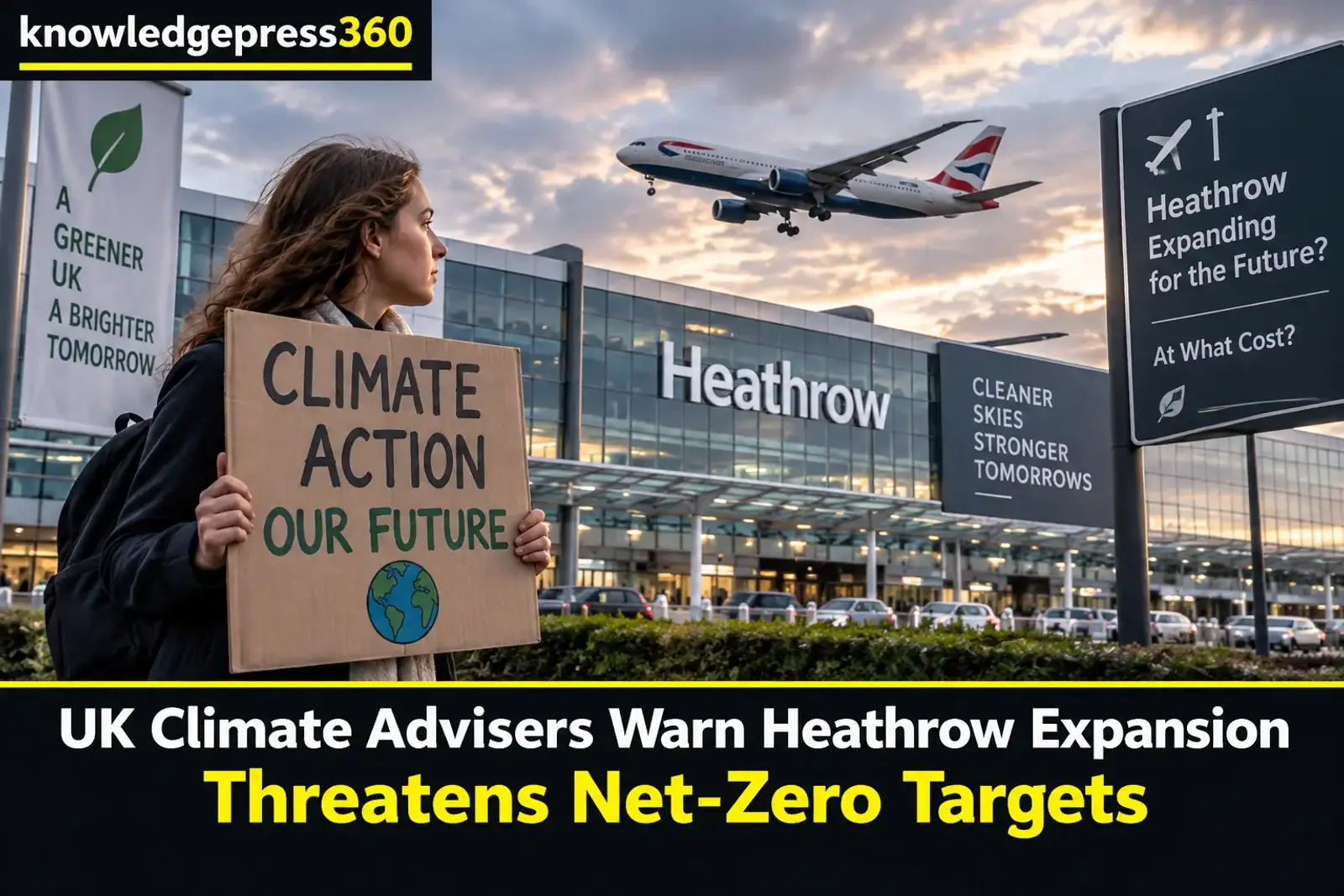
The intersection of aviation growth and national decarbonisation obligations has long sparked contentious debate among policymakers and environmental scientists alike. As the United Kingdom strives to meet its legally binding commitment to achieve net-zero greenhouse gas emissions by 2050, the proposed third runway at Heathrow Airport has re-emerged as a critical test of political resolve. While ministers have recently signalled support for advancing the infrastructure project to boost passenger capacity and international trade, independent experts warn that the underlying policy framework remains fundamentally inadequate. Navigating this tension requires a rigorous examination of how soaring aviation emissions could crowd out carbon reductions across the rest of the economy. Without sweeping regulatory shifts, the ambition to expand the nation's largest transport hub risks colliding violently with statutory climate laws.
Escalating Aviation Emissions and Carbon Budgets
Emissions generated by commercial flying have more than doubled since 1990, driven largely by surging passenger demand and affordable air travel. While nearly every other sector of the British economy has steadily curbed its carbon output over the past three decades, aviation has moved in the opposite direction. According to recent findings from the Climate Change Committee, the industry is currently on track to account for up to 80 percent of the United Kingdom's total carbon dioxide emissions by 2050. Even if no physical expansion takes place at Heathrow, baseline emissions from the sector are projected to reach approximately 38 million tonnes of carbon dioxide annually by mid-century. Building a third runway would pile on an additional 2.4 million tonnes annually upon opening, scaling up to 4.5 million tonnes once operations reach full maturity. Because achieving net zero requires balancing any residual pollution with active carbon removal from the atmosphere, allowing aviation emissions to balloon would absorb the vast majority of the nation's remaining carbon allowance, leaving virtually no margin for error.
Incompatible Infrastructure and Policy Gaps
In light of these projections, the Climate Change Committee has formally concluded that expanding Heathrow Airport is not currently compatible with the United Kingdom's statutory climate targets under existing policies. The independent advisory body emphasises that current government strategies lack the credibility required to reverse the upward trajectory of flight-related pollution. Ministers have frequently pointed to emerging technological solutions, such as sustainable aviation fuels and advanced efficiency measures, as viable pathways to cleaner skies. However, advisers caution that these techno-fixes remain underfunded, underdeveloped, and insufficient on their own to neutralise the sheer volume of anticipated carbon output. The core disagreement centres on whether large-scale airport expansion can proceed safely before robust, legally enforceable safeguards are fully operational across the entire commercial aviation sector.
The Heavy Financial Burden on Passengers
To bridge the chasm between aviation growth and net-zero mandates, advisers argue that the industry must be forced to internalise the true environmental cost of burning fossil fuels. This intervention would rely heavily on a strict polluter-pays framework, compelling airlines to finance expensive sustainable fuels and engineered carbon removal techniques, such as direct air carbon capture and storage. Implementing these mandatory green measures would inevitably translate into significantly higher ticket prices for consumers over the coming decades. Economic models suggest that passing these decarbonisation expenses directly onto passengers could inflate return ticket prices by £150 for flights to Alicante and by as much as £400 for routes to New York by 2050. Such steep increases raise profound equity questions regarding access to international travel, dividing opinion between frequent flyers and occasional holidaymakers who would bear the brunt of the transition costs.
Crucial Policy Decisions Ahead
As the government weighs its next steps ahead of a definitive decision on Heathrow expansion expected by 2029, the debate highlights deep divisions within the political landscape. While central government figures have expressed enthusiasm for the economic benefits of a third runway, regional leaders and environmental advocates continue to voice strong opposition. Key uncertainties remain regarding whether ministers will ultimately adopt the committee's stringent policy recommendations or implement targeted economic mechanisms, such as frequent flyer levies, to manage demand. Ultimately, the coming years will test whether the United Kingdom can successfully reconcile its aviation ambitions with its international climate leadership commitments.