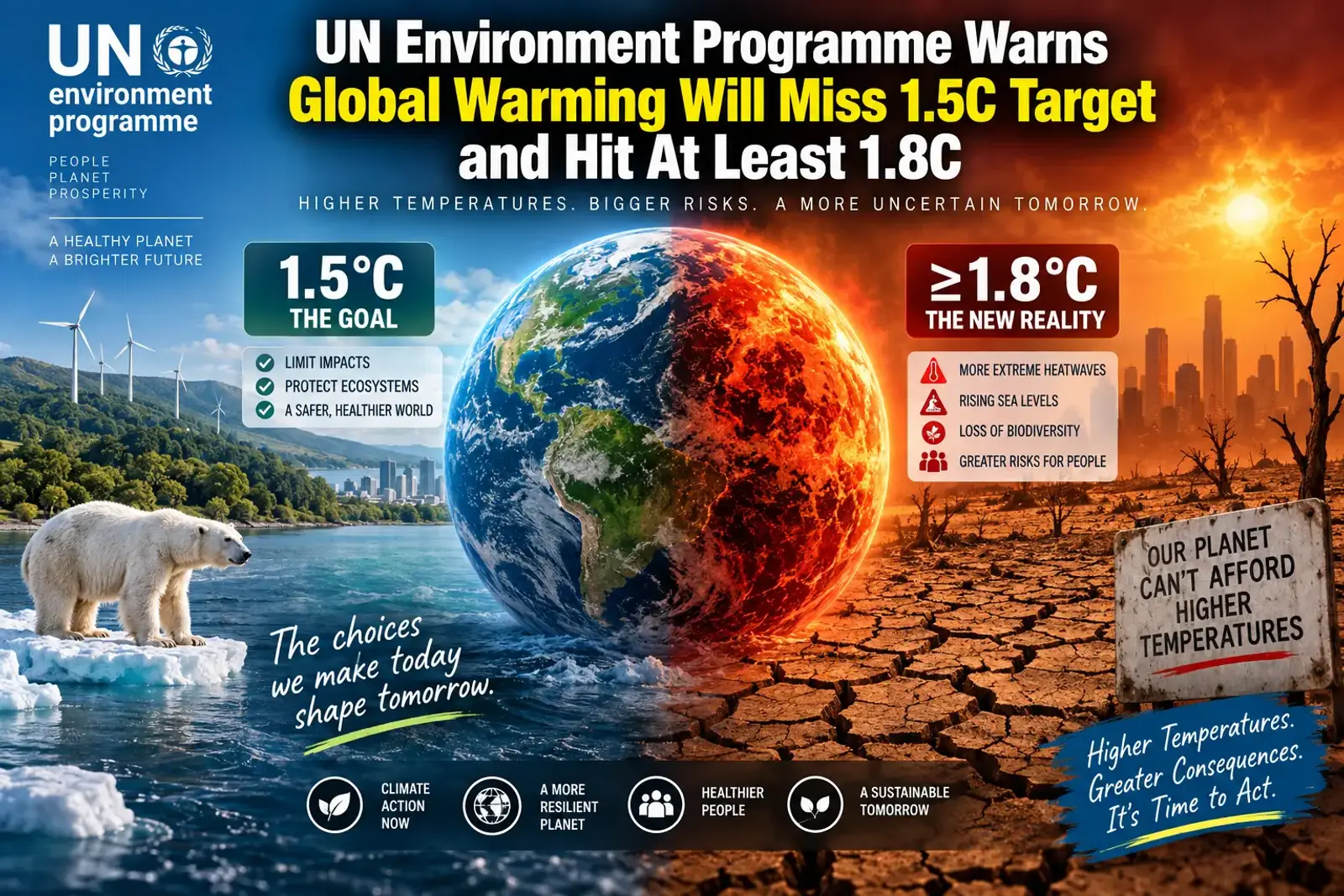
A landmark assessment published by the United Nations Environment Programme on September 2, 2026, has delivered a sobering evaluation of international climate efforts, concluding that temporary or prolonged breaches of the 1.5°C threshold established in the Paris Agreement are now unavoidable. The Nairobi-based agency warns that even under the most optimistic emissions reduction scenarios, global heating will reach at least 1.8°C above pre-industrial levels before any meaningful recovery can begin. This official acknowledgment marks a critical transition in global climate policy, shifting focus from pure prevention to managing an inevitable overshoot period while simultaneously working to bend the global temperature curve back down. This revelation matters profoundly because it forces governments, industries, and civil society to confront the reality of living through severe climate disruptions while racing to deploy large-scale remediation technologies.
The Limiting Overshoot Findings Released by the United Nations Environment Programme
The comprehensive report, titled Limiting Overshoot, details how decades of delayed action and persistent greenhouse gas emissions from fossil fuel combustion have locked the planet into a warming trajectory that current national pledges cannot halt. Global average temperatures have already risen by approximately 1.4°C, with annual averages having temporarily exceeded 1.5°C for the first time in 2024. Extrapolating current trends, scientists suggest that sustained warming of 1.5°C could become the permanent baseline around the end of this decade. Under current government policies alone, projections indicate that global warming could escalate to 2.6°C by 2100. The UNEP evaluation stresses that every five years of high emissions adds approximately 0.1°C to the eventual peak warming level, making immediate administrative and industrial interventions imperative to cap the ultimate temperature ceiling.
Severe Environmental Consequences of Surpassing the Paris Agreement Threshold
International researchers and UN officials are unified in the assessment that there are no good outcomes above 1.5°C, as every fraction of additional warming severely magnifies destructive weather extremes, severe heatwaves, catastrophic wildfires, and rapid glacier retreat. Unmitigated warming could lead to alpine glaciers losing more than a quarter of their total mass by 2100, subsequently driving global sea levels up by as much as 13 centimetres and threatening vulnerable low-lying island nations and coastal metropolitan areas with partial or total submersion. Furthermore, agricultural productivity faces severe threats, with global food production projected to decline by up to 14 percent by 2050 unless robust and comprehensive adaptation strategies are rapidly implemented across vulnerable regions. Ecosystems face irreversible damage, including the near-total destruction of warm-water coral reefs, which act as vital nurseries for marine biodiversity and sustain millions of livelihoods worldwide.
The Overshoot, Peak, and Decline Pathway Strategy
To navigate this dangerous horizon, the UNEP report outlines a rigorous overshoot pathway designed to peak heating around 1.8°C mid-century before employing large-scale carbon dioxide removal techniques to gradually cool the planet back down to 1.5°C by 2100. Achieving this relies on achieving net-zero greenhouse gas emissions as an indispensable milestone that cannot be bypassed. Crucially, the report emphasizes that carbon removal methods, such as large-scale afforestation and direct air capture, must operate strictly alongside deep, immediate cuts in fossil fuel pollution rather than serving as a convenient substitute. Leaders from climate-vulnerable areas, including Pacific Island nations, have seized upon these findings to demand accelerated phase-outs of fossil fuel extraction, pointing to international legal opinions that underscore the duty of states to protect populations from catastrophic climate harm.
Future Policy Milestones and Mitigation Challenges
As the international community digests the stark conclusions of the Limiting Overshoot report, attention turns toward upcoming global climate summits and the scheduled enhancement of national climate pledges. A primary variable in determining the success of any temperature-reduction strategy remains the future capacity of natural carbon sinks, such as forests and oceans, to absorb and store anthropogenic emissions under increasingly stressed climatic conditions. Furthermore, it remains to be seen whether global governments will enact sufficient and immediate legislative frameworks to fund and mandate carbon removal infrastructure on an unprecedented scale. Observers will closely monitor upcoming diplomatic forums to ascertain whether major economies are willing to align their domestic policies with the stringent demands of an overshoot and recovery pathway.