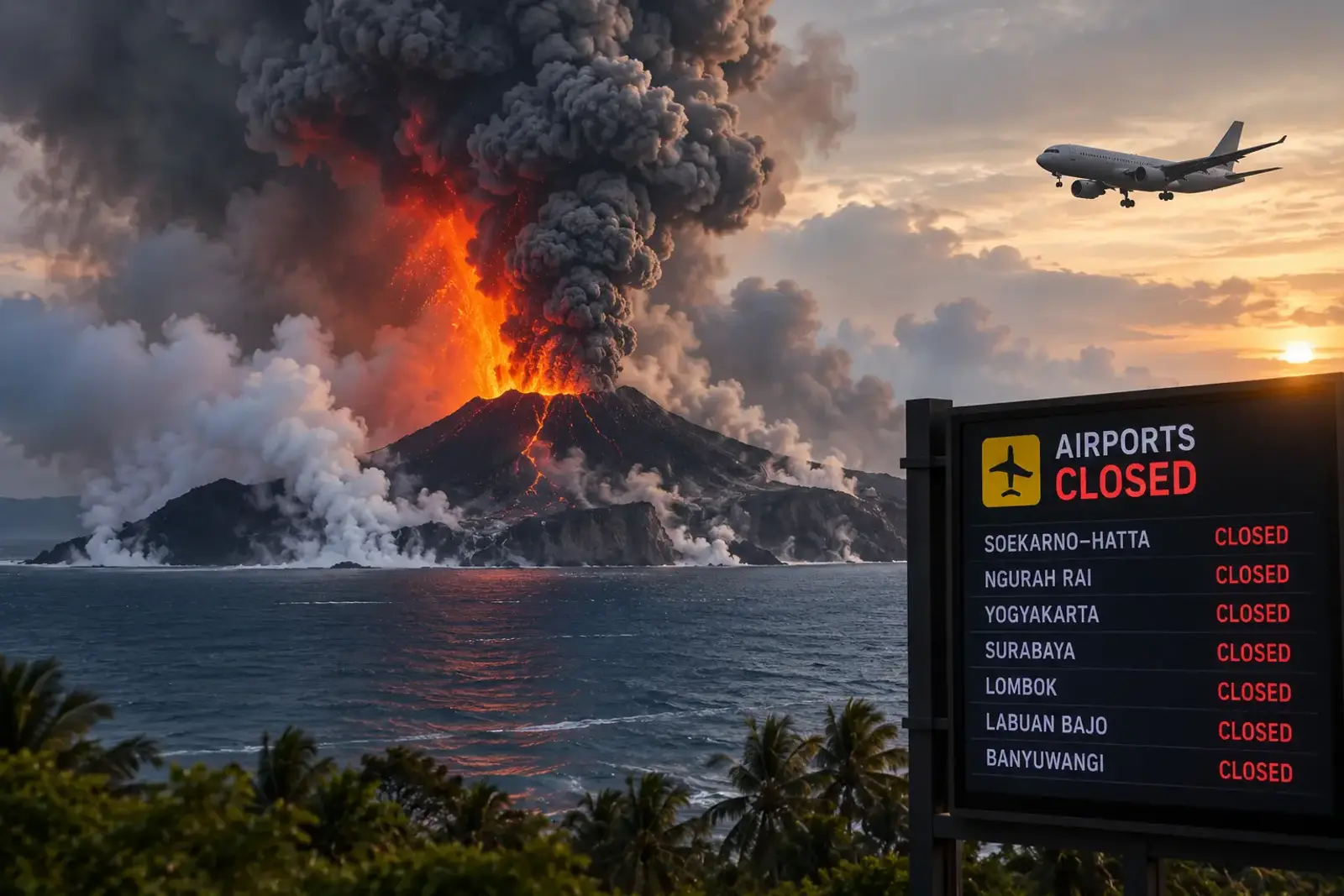
The sudden eruption of Mount Anak Krakatau has triggered widespread travel disruptions across Indonesia, forcing the closure of multiple airports and blanketing major urban centers in thick volcanic ash. As aviation authorities grapple with volatile atmospheric conditions, hundreds of thousands of passengers face severe delays, highlighting the persistent vulnerability of Southeast Asia's transport infrastructure to sudden geological hazards.
Grounded Operations at Soekarno-Hatta International Airport and Regional Hubs
Seven Indonesian airports, including vital aviation facilities serving the capital city of Jakarta, remained closed on Monday morning due to heavy accumulations of volcanic ash originating from Mount Anak Krakatau. The volcano, situated in the Sunda Strait between the major islands of Java and Sumatra, erupted late on Friday, September 4, 2026. The explosive activity sent towering plumes of ash skyward and illuminated the night sky with glowing red lava, creating an immediate and severe hazard to jet turbine engines.
Among the affected facilities is Jakarta’s main aviation gateway, Soekarno-Hatta International Airport in Tangerang, which announced that operations would remain suspended at least until 6 p.m. local time. While Atung Bungsu Airport in Pagar Alam, South Sumatra, managed to resume normal operations following a temporary shutdown, the remaining seven hubs stayed dark. International carriers have also been forced to adjust schedules; Singapore Airlines confirmed the cancellation of 18 flights scheduled for Monday alongside an early Tuesday departure.
Discrepancies in Passenger Impact and Statements from Transport Minister Dudy Purwagandhi
Quantifying the full scope of the disruption has proven challenging for transport officials, with official figures differing across reporting channels. The Indonesian transport ministry stated that more than 270,000 travellers have been affected by the delay, diversion, or cancellation of approximately 2,300 flights. However, alternative reports citing separate ministry datasets reference a lower figure of 170,000 affected individuals. This variation underscores the logistical complexity of tracking immediate cancellations across multiple domestic and international carriers.
Transport Minister Dudy Purwagandhi addressed the ongoing crisis by emphasizing the unpredictability of the situation. Authorities cannot ascertain when the disruptions will definitively end due to dynamic weather patterns that continue to push abrasive ash across critical flight corridors. Passengers stranded at Soekarno-Hatta International Airport have voiced mounting frustration over prolonged waiting times and the inherent uncertainty of dynamic scheduling adjustments.
Environmental Hazards and Remote Learning Measures Across Java and Sumatra
Beyond aviation, the volcanic activity has generated severe environmental and public health concerns across the region. Meteorological agencies reported that ash towers reached elevations of 6,000 metres on the Java side and surged up to 15,000 metres toward Sumatra and parts of Banten province. Local disaster mitigation agencies distributed protective masks to residents, urging them to minimize outdoor exposure to the sulfur- and silica-laden dust.
In response to the deteriorating air quality, educational authorities in Jakarta and Lampung enacted precautionary measures, shifting schools to remote learning to shield students from respiratory hazards. Volcanologists have noted that the current series of eruptions is unusually vigorous for Anak Krakatau, prompting the national volcano monitoring agency to warn that the probability of further explosive events remains high in the near term.
Monitoring Shifting Airspace Safety and Reopening Timelines in Indonesia
As Indonesia navigates this geological emergency, aviation regulators, meteorological bodies, and international airlines remain on high alert. The primary focus centres on continuous atmospheric monitoring to determine when particulate concentrations drop to safe thresholds for jet engines. With the nation situated firmly along the seismically volatile Pacific Ring of Fire, authorities must balance the economic pressures of mass airport closures against uncompromising safety mandates. Stakeholders will closely watch shifting wind patterns and ongoing monitoring reports to establish a reliable timeline for clearing the affected airspace and restoring normal regional connectivity.