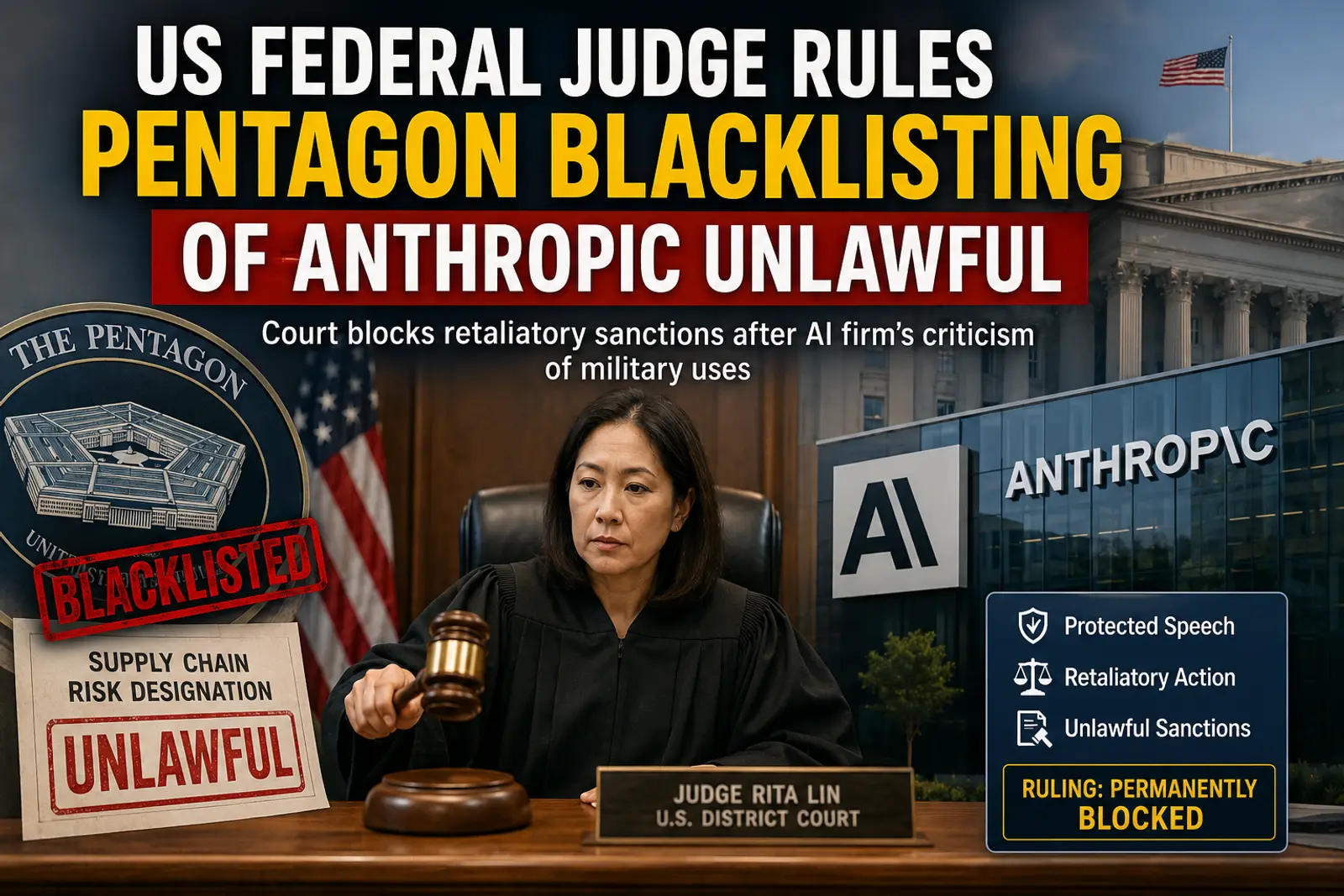
A federal court ruling has permanently blocked enforcement of sanctions and supply-chain restrictions against artificial intelligence developer Anthropic. US District Judge Rita Lin determined that the government acted unlawfully by retaliating against the company after its executives publicly criticized military applications of artificial intelligence. The decision marks a significant legal turning point in the relationship between technology providers and federal defense agencies, establishing boundaries regarding how the executive branch can wield national security justifications.
Federal Court Overturns Pentagon Supply Chain Risk Designation and Sanctions
In a 59-page opinion issued from the Northern District of California, Judge Rita Lin struck down the punitive measures directed at Anthropic, the creator of the Claude artificial intelligence models. The court found that Defense Secretary Pete Hegseth acted improperly in February when he designated Anthropic as a supply-chain risk, a classification historically reserved for foreign corporate entities rather than domestic technology companies. Furthermore, the ruling permanently invalidates directives issued by President Donald Trump that ordered federal agencies to cease utilizing Anthropic tools and to phase out existing technological integrations.
Judge Lin rejected the administration's reliance on national security rhetoric to justify the sanctions. In her written decision, she emphasized that invoking national security does not grant federal authorities a blank check to retaliate against entities exercising protected speech. The court noted that the government's actions violated statutory frameworks and constitutional protections, directly targeting Anthropic for expressing policy reservations rather than addressing substantiated supply-chain vulnerabilities.
Ethical Disagreements Over Autonomous Weapons and Mass Domestic Surveillance
The controversy originated from ethical and operational disagreements regarding the military implementation of artificial intelligence. Anthropic leadership declined to permit the United States military to deploy the Claude AI chatbot for programs involving mass domestic surveillance or the operation of fully autonomous weapons systems. Company executives maintained that current artificial intelligence models lack the reliability required for safe deployment in combat scenarios and argued that domestic surveillance applications violate civil liberties.
These policy positions drew condemnation from executive branch officials. President Trump publicly criticized the organization on social media, labeling it a radical left company. Defense Secretary Hegseth subsequently instituted commercial prohibitions, decreeing that no contractor, supplier, or partner conducting business with the United States military could maintain commercial ties with Anthropic. Legal representatives for Anthropic argued that these retaliatory measures caused financial disruption and reputational harm, effectively blocking the company from military contracts.
Pending Litigation in Washington and Future Procurement Standards
While the ruling provides relief by permanently converting a preliminary injunction into a permanent bar against enforcement, the legal battle surrounding the artificial intelligence firm remains ongoing. Anthropic continues to litigate a separate lawsuit currently pending in Washington, D.C. That distinct legal proceeding targets a parallel supply-chain risk designation that threatens the company's contracts across civilian government agencies.
Legal scholars and industry observers are evaluating the broader implications of Judge Lin's ruling for federal procurement standards and corporate autonomy. The decision addresses the tension over whether private technology enterprises can establish ethical boundaries for the deployment of their software without facing government retribution. Analysts note that the outcome sets a precedent protecting software developers from executive overreach when they raise safety concerns about emerging technologies.
Department of Justice Appeal Prospects and Milestone Developments
As the legal landscape continues to shift, attention turns toward the United States Department of Justice to determine whether federal attorneys will formally lodge an appeal against Judge Lin's ruling. Although the government retains the right to challenge the decision, legal experts suggest that defending the sanctions will present hurdles for appellate attorneys.
Concurrently, stakeholders across the defense sector and the artificial intelligence industry are monitoring the progression of the Washington, D.C., litigation regarding civilian agency contracts. The ultimate resolution of that remaining legal challenge, alongside any potential appellate proceedings, will shape the legal framework governing public-private partnerships in the national security sphere. These upcoming judicial milestones will clarify the extent to which private sector developers can participate in federal contracting while maintaining independent ethical standards for advanced artificial intelligence deployment.