Public health authorities are navigating a critical intersection of viral hemorrhagic fever management following updated international directives and cross-border outbreak evaluations. The World Health Organization has released vital emergency recommendations addressing the potential off-label administration of licensed Ebola vaccines during active transmissions of the Bundibugyo virus [1]. Concurrently, public health agencies have scrutinised the operational dynamics of recent transboundary outbreaks to refine regional preparedness frameworks [3]. These developments highlight both the urgency of deploying medical countermeasures against neglected viral strains and the complex administrative hurdles that test containment capacities in resource-limited settings.
World Health Organization Issues Emergency Guidelines for Ervebo During Bundibugyo Outbreaks
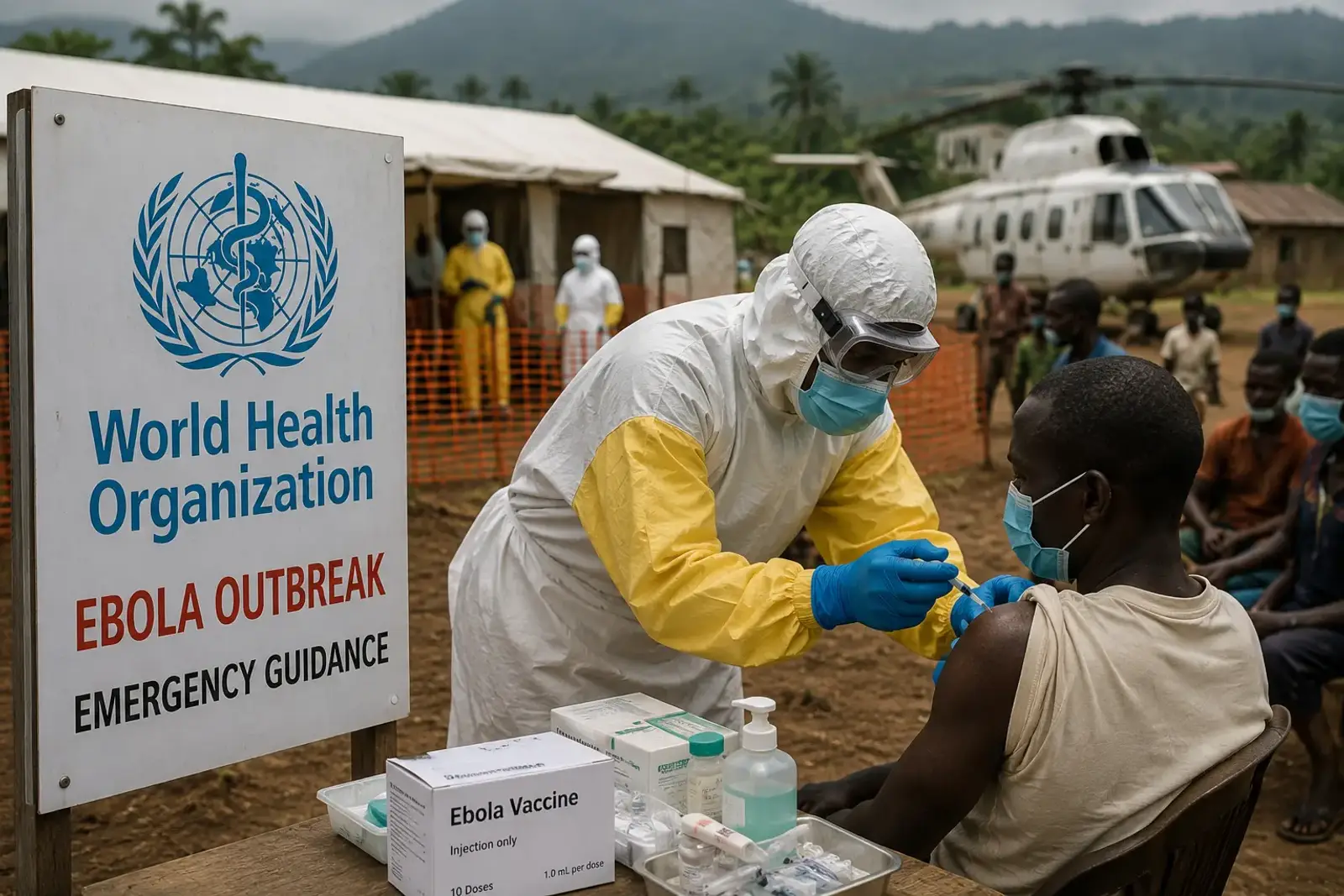
The World Health Organization formally issued updated emergency guidance addressing the off-label deployment of Ervebo, currently the sole licensed Ebola vaccine, during outbreaks driven by the Bundibugyo virus [1]. Operating through evaluations conducted by the Strategic Advisory Group of Experts on Immunization, health officials reviewed comprehensive animal models, immunological assays, and observational metrics [1]. The panel concluded that while certain preliminary findings hint at potential cross-reactive immunity, existing evidence remains fundamentally insufficient to verify whether Ervebo delivers clinically meaningful protection for human populations exposed to the Bundibugyo strain [1]. Consequently, international health advisors have stipulated that the vaccine must not be distributed indiscriminately but rather administered strictly within formalized research protocols, such as ring randomized controlled trials [1].
Cross-Border Transmission Dynamics and Timeliness Evaluations in Uganda and the Democratic Republic of the Congo
The clinical urgency of these immunization guidelines stems from a transboundary outbreak of Bundibugyo virus disease that emerged across Uganda and the Democratic Republic of the Congo [3]. Initiating in May 2026, the resurgence prompted an extensive early action review co-ordinated by regional health ministries and international partners [3]. Investigators utilized the established 7-1-7 framework, which mandates detection within seven days, notification within one day, and completion of early response actions within seven days, to audit operational efficacy across nine distinct pillars [3]. Uganda successfully met its core timeliness benchmarks, identifying its index case in six days, completing formal notification swiftly, and finalizing early containment protocols [3].
Operational Bottlenecks and Systemic Vulnerabilities Highlighted by Public Health Reviews
Despite meeting rapid initial timeliness targets during the cross-border evaluation, public health responders confronted severe operational bottlenecks that complicated disease control efforts [3]. Analysts identified low clinical suspicion among frontline medical personnel as a major impediment to early diagnosis, alongside fragmented digital data infrastructure that hindered real-time information sharing between districts [3]. Furthermore, delays in mobilizing community engagement strategies exposed persistent vulnerabilities in local communication channels [3]. These structural impediments demonstrate that achieving rapid laboratory detection and administrative notification requires robust clinical surveillance and community trust to prevent health systems from becoming vulnerable during active hemorrhagic fever events [3].
Strategic Priorities for Countermeasure Development and Future Outbreak Preparedness
Addressing the ongoing threat posed by the Bundibugyo virus requires a dual-track strategy combining rigorous clinical trials with accelerated countermeasure research [1]. Because Ervebo lacks definitive proof of human efficacy against this specific viral species, international agencies stress the absolute necessity of generating robust clinical data through controlled research designs while maintaining standard containment measures [1]. At the same time, scientific efforts focus on supporting the creation of dedicated vaccines and targeted therapeutics tailored specifically to the Bundibugyo strain [1]. By bridging these operational gaps and accelerating pathogen-specific drug development, global health networks can better protect vulnerable populations from future hemorrhagic fever emergencies [1, 3].